There’s a particular image that captures something important about how Sanatan tradition has historically understood women’s power: a woman in a Rajasthani village, seated in full ghoonghat, visible to the outside world only as a single hand and yet, inside that home, every major family decision passes through her. To an outside observer conditioned to read veiling as silence, this looks like powerlessness. To the community itself, it was often the opposite: the most covered woman was frequently the one making every decision that mattered.
This tension between how women’s roles in Indian spiritual and cultural life are often perceived from the outside, and what those roles have actually meant within the tradition itself sits at the center of how the Sanatan Sanskrutik Sangh (SSS), led by Haripriyaa Bharggav, approaches women’s participation in spiritual and cultural events. Rather than treating women’s involvement as a modern add-on to traditional practice, SSS positions it as a restoration of something foundational: Matru Shakti, Mother Power, understood as one of the central organizing forces of Sanatan civilization itself.
This blog examines how women’s participation in spiritual and cultural life is being actively reclaimed and reinvigorated through SSS’s programming, why this matters in the current global conversation about gender and religious leadership, and what the historical record actually shows about women’s authority within Indian tradition a record that complicates a great deal of received wisdom about where “real” women’s empowerment originated.
Matru Shakti: Women’s Power as Foundational, Not Peripheral
SSS’s guiding philosophy explicitly names Matru Shakti (Mother Power) and Yuva Shakti (Youth Power) as forces that must be “activated and honored” for India to achieve its full potential as Samruddha, Samarth, and Sanskrutik Bharat. This isn’t a peripheral inclusion; it’s structural. Women’s spiritual and cultural leadership is treated as one of the load-bearing pillars of the entire SSS Bharat vision, not a supplementary initiative running alongside the “real” work.
This framing draws on a specific Sanatan philosophical principle SSS repeatedly invokes: “Yatra Naryastu Pujyante Ramante Tatra Devata,” where women are honored, there the divine resides. This isn’t treated as poetic sentiment; it’s positioned as an operating principle with direct implications for how spiritual and cultural events should be structured, with women’s participation not merely welcomed, but central to the legitimacy and spiritual efficacy of the events themselves.
The Historical Record: Complicating the “Who Empowered Women First” Narrative
One of the more provocative threads running through SSS’s broader cultural content directly challenges a widely held assumption: that women’s rights and empowerment are primarily modern, Western achievements that India is still “catching up” to.
The historical comparison SSS draws is stark. As documented in officially recorded banking history, European women could not open bank accounts, vote, or independently own property until well into the 20th century, with these restrictions persisting in various European countries until as recently as 1950. Against this historical backdrop, SSS highlights figures like Rani Lakshmibai of Jhansi, who led an army into battle in 1857, and Ahilyabai Holkar, who governed and administered an empire in the 18th century, women exercising direct military and administrative authority in India centuries before their European counterparts could independently open a bank account.
This comparison matters for contemporary women’s participation in spiritual and cultural events for a specific reason: it reframes women’s leadership within Sanatan tradition not as a deficit to be corrected through imported feminist frameworks, but as a historical strength requiring restoration after centuries of erosion, much of it, per SSS’s broader historical narrative, tied to colonial-era disruption of indigenous social structures.
Flagship Events: Women’s Participation as Visible, Collective Power
Samuhik Mahila Kalash Yatra at Maha Kumbh 2024
Perhaps the most striking demonstration of SSS’s women’s participation strategy occurred at the Maha Kumbh 2024 in Prayagraj, where the Samuhik Mahila Kalash Yatra brought together over 5,000 women carrying kalash filled with holy water, chanting mantras, and walking in collective procession. This wasn’t simply women attending a religious event it was thousands of women organizing, coordinating, and executing a large-scale collective ritual action within one of the largest religious gatherings on Earth, an event increasingly drawing international scholarly and media attention as a phenomenon of mass human coordination and devotion.
The social impact logic here is significant: visible, large-scale collective action by women functions as a role-model effect at scale, demonstrating to onlooking communities, and to the participating women themselves, a tangible model of what women’s collective organizing capacity looks like, embedded within (not opposed to) traditional spiritual practice.
Sanatan Kalash Yatra
The Sanatan Kalash Yatra similarly centered women carrying sacred water in traditional processions, explicitly celebrating “the sanctity of womanhood and the divine feminine energy that nurtures dharma.” The event’s framing that the preservation of faith begins with the spiritual strength of women, who form the moral foundation of society, positions women not as recipients of spiritual guidance handed down from elsewhere, but as primary custodians and transmitters of dharmic continuity itself.
Samuhik Matrushakti Anushthan
The Samuhik Matrushakti Anushthan brought together thousands of women performing rituals and prayers dedicated to national peace and prosperity, explicitly honoring the nurturing, protective, and empowering force within every woman under Haripriyaa Bharggav‘s guidance. Events of this scale and structure function as sustained, recurring infrastructure for women’s spiritual community-building, rather than isolated, one-time symbolic gestures.
Leadership at the Top: Haripriyaa Bharggav as a Structural Signal
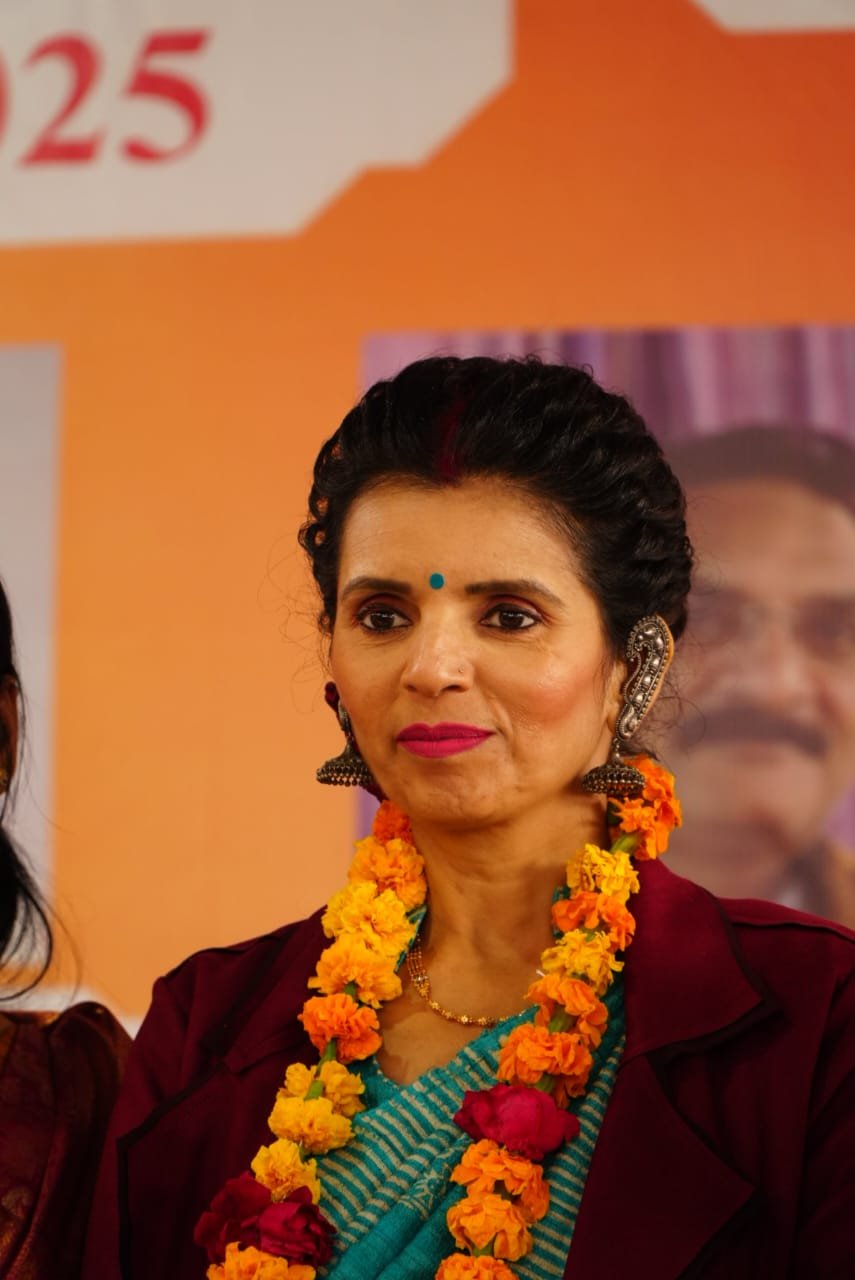
It would be incomplete to discuss women’s participation in SSS’s spiritual and cultural events without acknowledging the significance of the organization’s own leadership structure. Haripriyaa Bharggav serves as Chairperson of the entire Sanatan Sanskrutik Sangh, meaning the movement’s women’s participation initiatives aren’t being led by outside advocates on behalf of women, but by a woman occupying the organization’s highest spiritual and administrative authority.
This matters structurally in a way that pure programming cannot fully replicate. Haripriyaa Bharggav’s own biography, rising from early work providing legal guidance to underprivileged women, through a demanding entrepreneurial career spanning finance, technology, and media, to leadership of a national interfaith spiritual movement, offers a lived demonstration that women’s authority within Sanatan tradition extends to its highest organizational and spiritual leadership positions, not merely its participatory or supportive roles.
Her personal history of overcoming serious physical adversity, including a prolonged spinal injury and a Stage III cancer diagnosis, before rebuilding both her business ventures and her cultural leadership work adds a dimension of earned resilience-based authority that resonates strongly with contemporary conversations about women’s leadership emerging through hardship rather than inherited privilege.
Reframing Traditional Practices Through a Contemporary Lens
Part of what makes SSS’s approach to women’s participation distinctive is its willingness to actively reinterpret traditional practices that might otherwise be read, particularly by external or younger audiences, as symbols of restriction rather than power.
The reframing of the ghoonghat (veil) as a symbol of concentrated household authority rather than silencing is one clear example, presenting historical rural governance patterns where the most visibly “covered” woman frequently functioned as the family’s actual decision-making authority. Similarly, SSS’s broader content reclaims linguistic terms, noting, for instance, the etymological distinction between imported titles and the Sanskrit-derived “Shrimati” (from Shri + Mati, combining prosperity and wisdom) as more accurate and dignified terminology for married Indian women, compared to imported Western titles with more complicated historical connotations.
This reframing work matters for women’s participation in spiritual and cultural events specifically because it addresses a real psychological barrier: many younger Indian women, exposed primarily to Western feminist frameworks through mainstream media and education, may approach traditional practices with pre-existing skepticism about whether those practices are compatible with contemporary values around autonomy and equality. SSS’s content strategy directly engages this skepticism by making the case, using historical evidence, that many traditional Indian practices encoded women’s authority in ways that require reinterpretation, not rejection.
Why This Conversation Is Especially Relevant Right Now
Several current trends make women’s participation in spiritual and cultural life a particularly timely and resonant topic:
- Global Conversations About Women in Religious Leadership: Across multiple faith traditions worldwide, there is active, ongoing debate about expanding women’s formal leadership roles within religious institutions. SSS’s structural positioning of women at the highest organizational levels, combined with theologically grounded arguments for women’s spiritual authority, contributes a distinctly Indian voice to this global conversation.
- The “Reclaiming Feminism” Movement Among Young Indian Women: There’s a growing cultural conversation among young Indian women interested in reclaiming indigenous frameworks of empowerment rather than exclusively adopting imported Western feminist vocabulary, seeking figures like Rani Lakshmibai and Ahilyabai Holkar as authentically Indian models of women’s power, predating and distinct from Western suffrage-era feminism.
- Kumbh Mela’s Rising Global Visibility: As the Maha Kumbh continues to draw unprecedented international attention as one of the largest peaceful human gatherings on Earth, women’s large-scale collective participation within it, like the 5,000-strong Samuhik Mahila Kalash Yatra, gains visibility on a genuinely global stage.
- Women-Led Entrepreneurship and Business Leadership: With growing global attention to women-led enterprises and business leadership, Haripriyaa Bharggav’s dual role as both a diversified business leader and spiritual movement chairperson offers a compelling, integrated case study increasingly relevant to conversations about women navigating both economic and cultural leadership simultaneously.
- Interest in Indigenous and Traditional Women’s Networks: Global development and anthropology research increasingly recognizes traditional women’s collectives and ritual networks as legitimate, effective forms of community organizing, validating SSS’s model of building women’s empowerment work around existing spiritual and cultural gathering structures, rather than exclusively through imported NGO or civil-society frameworks.
The Deeper Argument: Empowerment Doesn’t Require Cultural Rupture
Perhaps the most important underlying argument in SSS’s approach to women’s participation is a direct challenge to a common assumption: that women’s empowerment in India necessarily requires distancing from, or actively rejecting, traditional spiritual and cultural practice.
SSS’s model proposes something different: that traditional Sanatan spiritual and cultural life already contains sophisticated, historically grounded frameworks for women’s authority and leadership that were disrupted, diminished, or obscured over historical time, rather than frameworks that never existed and must now be imported wholesale from elsewhere. The task, in this view, is not to choose between tradition and empowerment, but to restore tradition’s own empowering dimensions, which colonial disruption and subsequent narrative erosion had pushed to the margins.
This is a genuinely distinctive contribution to contemporary gender discourse, neither uncritically traditionalist (ignoring real historical instances of restriction or inequality within some interpretations of tradition) nor wholesale rejectionist (assuming empowerment must come entirely from outside frameworks). It occupies a specific, carefully argued middle position: critical restoration, reclaiming and re-elevating the empowering threads that were always present within the tradition, while explicitly working to address inequities.
Measuring Impact: What Women’s Participation Actually Achieves
Beyond the symbolic significance of large gatherings, SSS’s women’s participation initiatives can be evaluated against several concrete outcomes:
- Scale of collective mobilization: over 5,000 women coordinated at Maha Kumbh 2024, demonstrating genuine organizing capacity
- Institutional leadership representation: a woman chairing the entire national organization, not merely leading a “women’s wing”
- Cross-generational transmission: women’s central role in cultural and ritual events reinforcing their historical function as primary carriers of dharmic continuity within families
- Narrative and historical reframing: content actively repositioning Indian women’s historical authority relative to global comparisons, building cultural pride and psychological ownership over empowerment narratives
- Economic-spiritual integration: women’s participation in livelihood initiatives (like Bhusattva’s textile revival) running parallel to spiritual leadership programming, addressing empowerment holistically rather than in silos
Conclusion: Power That Was Always There, Waiting to Be Recognized
The story SSS tells about women’s participation in Sanatan spiritual and cultural life isn’t a story about granting women new power they never previously held. It’s a story about recognizing, restoring, and amplifying authority that Sanatan tradition, at its philosophical core, always assigned to women authority that historical disruption, cultural erosion, and incomplete narrative transmission obscured, but never fully erased.
From the 5,000 women walking together at Maha Kumbh, to the historical memory of Rani Lakshmibai leading armies into battle, to Haripriyaa Bharggav herself leading both a business empire and a national spiritual movement, the throughline SSS traces is consistent: Matru Shakti was never absent from Indian civilization. It was waiting to be visibly, collectively, and confidently reclaimed.
As global conversations about gender, religion, and leadership continue to evolve, Sanatan Sanskrutik Sangh‘s model offers something genuinely useful: proof that women’s spiritual and cultural leadership doesn’t need to be imported, invented, or negotiated as a modern concession it needs only to be remembered, restored, and given the platform to be seen at scale.