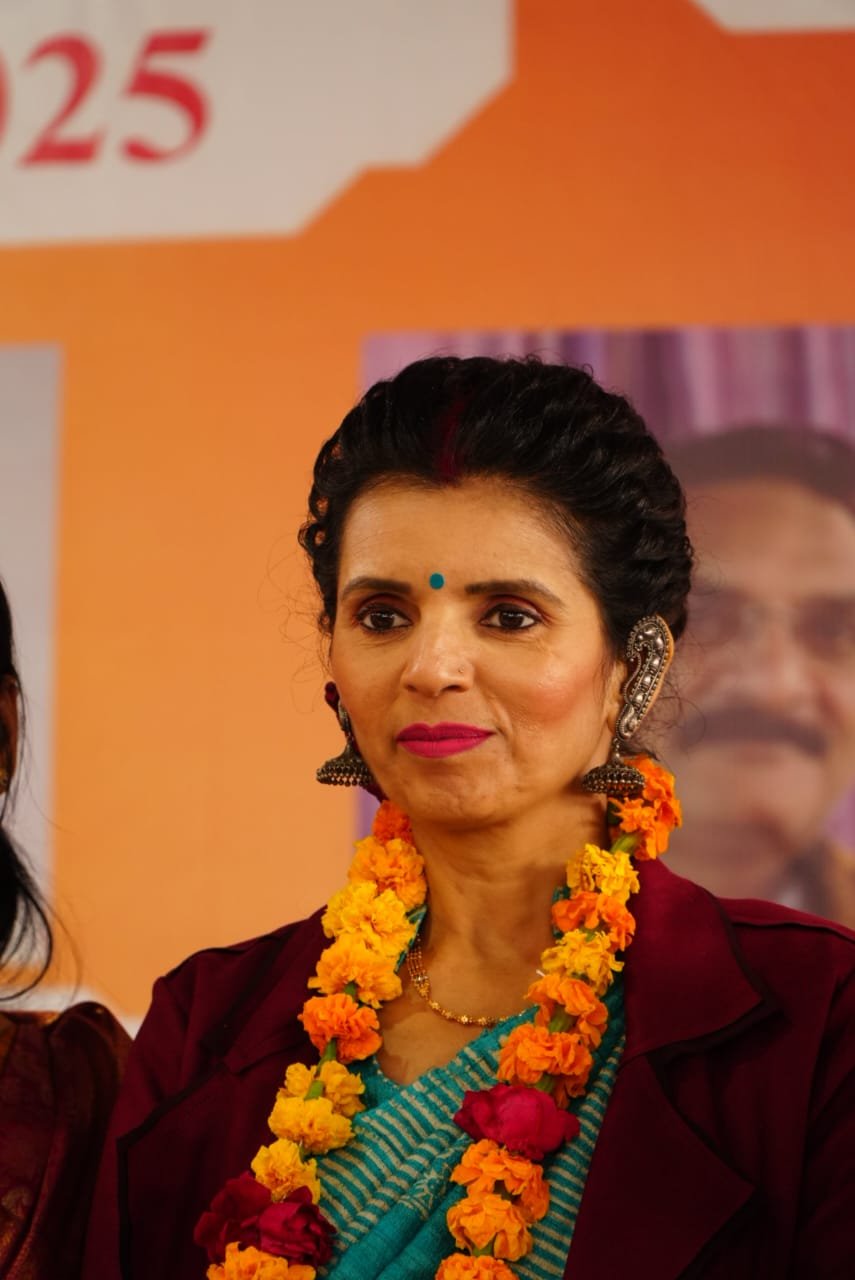
Every great national movement eventually arrives at the same question: what does this mean for me? It is one thing to admire a vision from a distance and nod along at the idea of a prosperous, capable, and culturally rooted India, and quite another to ask what role an ordinary citizen actually plays in building it. This is the question at the heart of SSS Bharat, the movement founded by industrialist and cultural leader Haripriya Bhargav, Chairperson of the Sanatan Sanskrutik Sangh (SSS).
SSS Bharat is built on three pillars: Samruddha Bharat (an economically self-reliant India), Samarth Bharat (an empowered and capable India), and Sanskrutik Bharat (a culturally rooted India). Together, these pillars describe a nation that does not depend on borrowed prosperity, borrowed values, or borrowed identity a Bharat that draws its strength from its own civilizational roots while still engaging confidently with the modern, globalized world.
But a vision this size cannot be built by any one person, however capable, or by any one organization, however well-resourced. Haripriya Bharggav has been explicit about this in her own words: the call is not for a select few to act on behalf of the many, but for every citizen regardless of profession, income, location, or age to move from being nishkriya (passive) to sakriya (active). This blog explores exactly what that shift can look like in practice, and how ordinary citizens, families, professionals, and communities can each find their own entry point into the SSS Bharat vision.
Understanding the Three Pillars Before Acting
Before discussing contribution, it helps to understand what each pillar of SSS Bharat is actually asking of citizens, because the nature of the contribution differs by pillar.
Samruddha Bharat: is about economic sovereignty, not simply national wealth, but a citizenry that is self-reliant, financially literate, and unwilling to build its life on borrowed money disguised as progress. This pillar draws directly on the idea of Swavalamban, or self-reliance, and imagines villages and communities that are prosperous enough that people choose to stay, rather than migrate to cities out of desperation.
Samarth Bharat: is about capability and empowerment, particularly among the young. It responds to what Haripriya Bharggav has repeatedly identified as the central crisis of this generation: that Gen Z and Gen Alpha are fluent in global trends but often disconnected from their own cultural and civilizational roots, and that this gap was allowed to widen because the generations responsible for transmitting that knowledge Millennials and Gen X did not do so.
Sanskrutik Bharat: is about cultural identity, ensuring that India’s citizens know their own history, philosophy, and traditions well enough that they are not living inside someone else’s narrative about who they are. This pillar is less about preserving artifacts of the past and more about equipping people with living knowledge they can carry into modern life.
Every act of contribution to SSS Bharat, however small, tends to serve one or more of these three pillars. Understanding which pillar a given action serves can help citizens choose contributions that feel authentic and sustainable rather than performative.
Contribution Starts at Home
If there is one message that runs consistently through the SSS Bharat philosophy, it is this: transformation always starts from within, and the first unit of that transformation is the family.
Haripriya Bharggav has spoken directly to parents and capable adults on this point: raising a child today cannot stop at school fees, gadgets, and achievements. Alongside school fees, she argues, parents must give sanskar (values). Alongside gadgets, they must give identity. Alongside achievements, they must give wisdom. This is not a call to reject modern education or technology; it is a call to ensure that cultural and moral grounding travels alongside them, rather than being left behind.
In practical terms, this can look like:
- Setting aside regular time, even just once a week, to share stories, festivals, or family history with children, rather than assuming schools or the internet will do this work.
- Teaching children the meaning behind rituals and festivals they participate in, not just the actions themselves, so that practice is paired with understanding.
- Modeling the values you want to see since children rarely internalize what parents say if it isn’t reflected in what parents do. Haripriya Bhargava’s own framing is blunt on this point: there is no such thing as a “generation gap,” only a values gap, and it is one that adults themselves created and are therefore responsible for closing.
- Encouraging children to ask questions about their own heritage rather than treating cultural literacy as something to be absorbed passively.
None of this requires wealth, institutional access, or public visibility. It requires intention. This is precisely why the family is described as the first and most foundational unit of contribution to SSS Bharat because it is the one institution nearly every citizen already has some influence over.
Financial Contribution Doesn’t Mean What You Think
When people hear “contribute to a national economic vision,” they often assume this means donating money or investing capital, and while philanthropic and financial support absolutely matters to a movement like SSS Bharat, the deeper financial contribution being asked of citizens is behavioral, not transactional.
SSS Bharat draws on an old formula, attributed to ancient Indian financial wisdom, dividing personal income into four equal parts: roughly a quarter toward necessities, a quarter toward savings, a quarter toward donation, and a quarter toward luxury. The philosophy behind this framework isn’t really about the exact percentages; it’s about balance. Prosperity built entirely on debt or unchecked luxury spending is, in this view, not real prosperity at all, but an illusion that eventually collapses under its own weight.
For an individual citizen, contributing to Samruddha Bharat can be as simple as:
- Practicing genuine financial discipline, living within one’s means rather than normalizing debt-funded lifestyles.
- Making saving and donation habitual rather than occasional, so that both wealth-building and generosity become part of a household’s rhythm rather than afterthoughts.
- Supporting local and indigenous businesses, artisans, and producers where possible, rather than defaulting to convenience alone a choice that, multiplied across many households, has real effects on local economic resilience.
- Teaching children financial literacy early, so the next generation inherits financial discipline rather than financial anxiety.
This kind of contribution doesn’t require anyone to be wealthy. It requires citizens to see their own household economy as a small but real building block of the larger vision of an economically sovereign Bharat.
Rural Engagement: The Village as the Unit of Renewal
One of the more distinctive aspects of the SSS Bharat vision is its emphasis on villages, not just cities, as the true measure of the nation’s health. Haripriya Bharggav has spoken about her own discomfort with the steady migration from villages to cities not because cities are the problem, but because that migration is too often driven by desperation rather than choice. Her stated goal is to help build villages so self-sufficient and culturally vibrant that people return to them with pride, rather than leaving them out of necessity.
This is reflected structurally in SSS’s Total Village Development Programme (TVDP), which is being rolled out across Bundelkhand and other parts of northern India, focused on expanding healthcare access, improving educational infrastructure, promoting self-reliance initiatives, and spreading cultural and religious awareness at the village level.
For citizens who live in or have ties to rural or semi-urban India, contribution can take several forms:
- Participating in or supporting local health camps, literacy drives, and skill-building workshops, whether as a volunteer, a donor, or simply as someone who shows up and spreads awareness.
- Advocating for and using locally produced goods, textiles, agricultural products, and handicrafts, which keeps economic value circulating within rural communities rather than flowing entirely outward.
- Mentoring or supporting young people from rural areas who are pursuing education or entrepreneurship, helping ensure that talent doesn’t have to leave home permanently to find opportunity.
- Sharing accurate information about rural India’s history and contributions, countering the narrative, common in urban circles, that rural life is simply a placeholder stage before “real” development happens in cities.
Even citizens who live in metros can contribute here, whether through financial support for rural development initiatives, by choosing to source goods from rural producers, or by simply ensuring their own families maintain living connections to ancestral villages rather than letting those ties dissolve entirely.
Cultural Literacy as a Civic Duty
Perhaps the most accessible and most overlooked form of contribution to SSS Bharat is simply becoming culturally literate oneself. This is the essence of Sanskrutik Bharat: a citizenry that knows its own scriptures, history, philosophy, and traditions well enough to engage with the modern world from a position of confidence rather than confusion.
Haripriya Bharggav has been direct about why this matters: those who don’t know their own legacy end up living inside someone else’s narrative about who they are. In an age of globalization, where younger generations are fluent in international trends but often unable to answer basic questions about their own heritage, this isn’t an abstract concern; it’s treated as a live civilizational risk.
Citizens can contribute to cultural literacy in very concrete ways:
- Self-education first. Reading foundational texts, attending discourses, or simply asking elders in one’s own family about traditions and their meanings is a starting point available to virtually everyone.
- Supporting Vedic Pathshalas and similar educational institutions, whether through direct involvement, volunteering time, or financial contribution, as these are positioned as central to reviving structured cultural education for the next generation.
- Participating in community events such as yatras, aartis, and cultural gatherings not as passive attendees, but as active participants who help sustain the collective energy these events are meant to generate.
- Using digital platforms responsibly to share accurate cultural and historical knowledge rather than letting social media be dominated entirely by imported trends and narratives.
- Correcting misinformation when encountered, gently and with evidence, rather than letting distorted narratives about Indian history and culture go unchallenged in everyday conversation.
This form of contribution costs little beyond time and attention, and it compounds. A citizen who becomes genuinely knowledgeable about their own heritage is far better equipped to pass that knowledge on to children, students, colleagues, or simply to conversations that would otherwise default to imported assumptions about what counts as “modern” or “progressive.”
Professional and Capability-Based Contribution
SSS Bharat’s call to action is explicitly addressed to what Haripriya Bharggav calls the saksham, the capable. Her framing is pointed: every capable, successful person carries a responsibility that goes beyond their own personal achievement. The specific language used is instructive: you may have resources but not be using them for society; you may have knowledge but not be sharing it; you may have influence but not be leading; you may have time but not be committing it; you may have capability but be staying silent. The gap between capability and action, in this framing, is described as the defining crisis of the present moment.
This means contribution doesn’t have to look the same for everyone it should look like whatever a person is actually good at.
- Professionals doctors, lawyers, teachers, engineers, businesspeople can contribute through pro bono work, mentorship, or simply making their expertise available to community initiatives that need it, whether that’s SSS-led health camps, legal aid drives, or educational programs.
- Business owners and entrepreneurs can look to Haripriya Bhargava’s own model, building commercially successful ventures while directing resources and organizational energy toward cultural and social initiatives, proving that profit and purpose can reinforce rather than compete with each other.
- Media and content creators can use their platforms to share accurate history, cultural knowledge, and constructive narratives, rather than defaulting to purely commercial or imported content.
- Students and young professionals, even without significant resources, can contribute time volunteering at events, organizing awareness campaigns on campuses, or simply engaging seriously with the ideas SSS Bharat is putting forward rather than dismissing them as background noise.
- Retirees and elders often carry the deepest reservoirs of cultural knowledge and life experience; their contribution can be as simple as making themselves available to younger generations who are actively seeking that knowledge but don’t know where to find it.
The underlying principle is consistent across all these categories: don’t wait for a formal invitation to contribute what you already have. The invitation, as SSS Bharat frames it, has already been extended to every capable citizen.
Environmental Stewardship as a Sanatan Duty
SSS Bharat also asks citizens to see environmental responsibility not as an imported Western concern, but as a core and ancient part of Sanatan philosophy rooted in the protection of the five elements: earth, water, air, sky, and fire. This reframing matters because it changes environmental action from something citizens might feel obligated to do for global reasons into something framed as a direct spiritual and civilizational responsibility.
In practice, citizens can contribute through:
- Participating in local river-cleaning and conservation drives, echoing initiatives like SSS’s Ganga cleaning campaigns.
- Supporting or establishing local shelters and welfare programs for animals, particularly cows, which hold deep cultural significance in this framework.
- Reducing plastic use, conserving water, and making small but consistent lifestyle adjustments that reflect genuine respect for natural resources rather than performative gestures.
- Planting trees and supporting reforestation or bird conservation efforts at the community level.
These actions, taken individually, may seem modest. But SSS Bharat’s broader philosophy treats the five elements as an interconnected ecosystem, meaning that consistent, distributed action across millions of citizens is understood to matter more than a handful of large, centralized interventions.
Women and Youth: Two Pillars Within the Pillars
Two groups receive particular emphasis within the SSS Bharat framework: women (Matru Shakti) and youth (Yuva Shakti).
For women, contribution is framed not as a supporting role but as a central, active force, reflected in SSS-led initiatives like the Sanatan Kalash Yatra and the Samuhik Matrushakti Anushthan, which explicitly celebrate and mobilize women’s spiritual and organizational leadership. Women citizens can contribute as women as community leaders, taking on visible leadership roles in community and cultural initiatives, mentoring younger women, and resisting the notion that cultural or spiritual leadership is somehow secondary to economic participation.
For youth, the ask is more foundational: to actively seek out cultural knowledge rather than waiting passively to receive it, to question imported narratives rather than absorbing them uncritically, and to see participation in movements like SSS Bharat not as an old-fashioned obligation but as a genuine act of identity-building in a globalized world that often erases distinct cultural identities by default.
Conclusion: Small, Consistent, Distributed Action
The vision of SSS Bharat is large by design: a nation that is simultaneously economically sovereign, empowered, and culturally rooted is not a small ambition. But the mechanism for achieving it, as Haripriya Bharggav has framed it repeatedly, is not centralized or top-down. It depends on millions of individual citizens making consistent, distributed choices: teaching values at home, practicing financial discipline, supporting rural communities, becoming culturally literate, contributing professional skill where it’s needed, and treating environmental stewardship as a duty rather than an obligation imposed from outside.
None of these actions, taken alone, will transform a nation. But taken together, sustained over time, and multiplied across a population willing to move from passive to active, from nishkriya to sakriya, they represent exactly the kind of grassroots, civilizational renewal that SSS Bharat is built to inspire. The invitation is open to every citizen, regardless of profession, income, or location. The only real requirement is the willingness to begin.