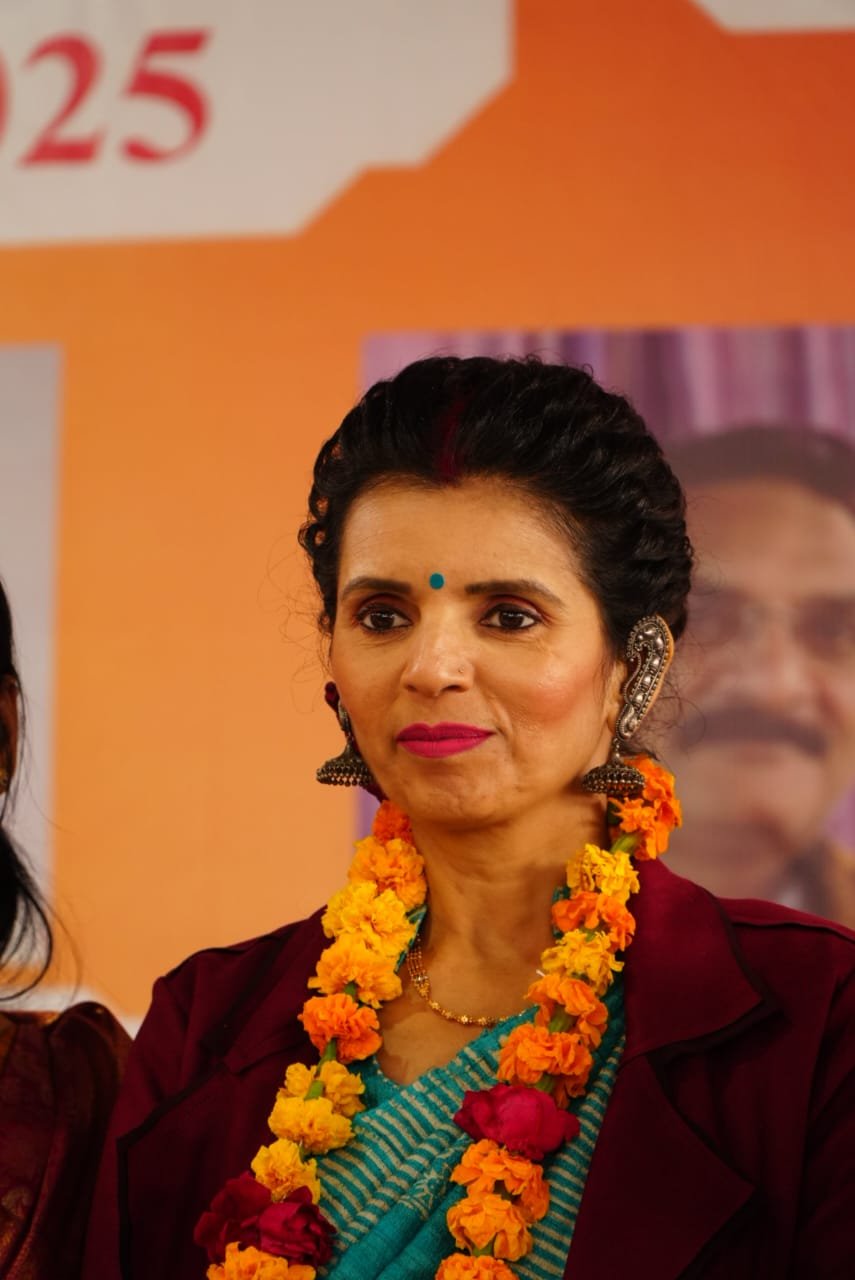
There is one conviction that has guided every chapter of my life from my childhood in Lalitpur to my years in uniform, from boardrooms in Mumbai to village courtyards in Bundelkhand and I have expressed it in a single sentence: when the roots of a tree are strong, no storm can bring it down; and when the roots of our culture are deep, no force can weaken our identity.
Everything I wish to say in this blog is an unfolding of that sentence. Because the question before our generation is not whether Bharat will grow; it is growing, visibly, in every field. The question is whether Bharat will remain Bharat while it grows. Will our children inherit not only our prosperity but our identity? Will they know why the diya is lit, why the tulsi is watered, why the elders are touched at the feet, why the river is called Mother? Or will they inherit a country that looks like Bharat on the map and like somewhere else in the mind?
This is why I believe the preservation of Sanatan Sanskriti and Indian traditions is not a sentimental hobby for the nostalgic. It is the central civilizational task of our time as urgent as the economy, as strategic as defence, because a nation that loses its culture has lost the very thing its economy and defence exist to protect.
What Exactly Are We Preserving? Understanding Sanatan Sanskriti
Before we speak of preservation, we must be clear about what we are preserving because Sanatan Sanskriti is widely misunderstood, sometimes even by its own children.
Sanatan means eternal, that which has no beginning and no end, that which is not founded by any one prophet at any one date, but discovered, refined, and transmitted by an unbroken chain of rishis across thousands of years. And Sanatan Dharma, in its original vastness, is not the property of a single sect. It is the shared spiritual foundation from which the Vedic, Jain, Buddhist, and Sikh traditions have all flowed one eternal river in many streams, all pursuing the same truths of moksha, devotion, rebirth, and righteous living. Over the centuries, fragmented interpretations taught us to see these paths as separate religions. I have always maintained the opposite: they are expressions of one divine tradition. We are all Sanatani. In this sense, promoting Sanatan Dharma is not about expanding a faith but about preserving the timeless values, wisdom, and way of life that have united generations across Bharat.
And Sanatan Sanskriti, the culture that grew from this dharma, is not merely a collection of rituals. It is a complete civilizational operating system: a way of eating, greeting, marrying, building, farming, trading, celebrating, mourning, and dying, in which every practice is connected to a deeper principle. Our sanskriti is dharma made visible in daily life. That is what we are called upon to preserve, not a museum of customs, but a living intelligence.
The Lesson of Vanished Civilizations
Why does preservation matter so much? History answers with a graveyard.
Egypt still has its pyramids, but the civilization that built them its language, its worldview, its gods, its way of life is gone; today’s Egyptians are disconnected from the people of the Pharaohs by an unbridgeable cultural rupture. Mesopotamia, Greece, Rome, Persia, the Maya the ancient world is a museum of civilizations that possessed dazzling wealth, armies, and monuments, and yet vanished as living cultures. Their descendants walk on their ancestors’ land but no longer speak their ancestors’ language, sing their songs, or think their thoughts.
And then there is Bharat. For five thousand years and more, on the same soil, we have continued the same civilization. The Vedas chanted today in a Bundelkhand pathshala are chanted with the same swaras our rishis fixed millennia ago; the oldest continuously transmitted texts of humanity, preserved syllable by syllable, generation after generation, largely without paper, through the discipline of memory and the devotion of families. The Kumbh still gathers crores as it always has. The same Ganga is still worshipped, the same festivals still mark our calendar, the same namaste still joins our palms. These Spiritual Events in India represent the living continuity of traditions that have preserved faith, community, and cultural identity across generations.
This survival was not an accident. It happened because our ancestors treated culture as a sacred trust to be transmitted, not a fashion to be discarded. Every generation understood itself as a link in a chain receiving the fire from the previous generation and passing it, undimmed, to the next. Invasions came, colonization came, famines and upheavals came, and the chain bent but never broke because the roots were deep. The moment we stop transmitting, we join the graveyard of civilizations within two generations. That is how fast a five-thousand-year flame can go out: not by conquest, but by one generation simply forgetting to hand it over.
Traditions Are Not Superstitions: The Encoded Wisdom of Our Ancestors
One of the greatest obstacles to preservation is the colonial habit which we have sadly internalized of dismissing our traditions as superstition. My experience has been the opposite: the deeper you study any genuine Indian tradition, the more intelligence you find encoded within it.
Consider our environmental philosophy. The world today speaks of climate change as a modern discovery; our scriptures documented ecological responsibility thousands of years ago through the doctrine of the Panch Tatva: Prithvi, Jal, Vayu, Akash, and Agni, whose protection is declared our supreme duty. Our tradition understood the world as one interconnected ecosystem: disturb one element and all are disturbed. Throw plastic and the water is contaminated; pollute and the air turns toxic; burn the forests and misuse energy and even fire is imbalanced; strip the trees, and the earth turns barren. Environmental consciousness is not an imported Western concept; it is the most ancient core of Sanatan philosophy, and one who protects the five elements is the most authentic Sanatani. When we worship rivers as mothers, trees as sacred, and the earth as Bhumi Devi, we are practising the world’s oldest ecology, wrapped in reverence so that it would be followed, not merely understood.
Consider our family tradition. The joint family is often mocked as an outdated arrangement, but it was, in truth, a robust economic model that shared resources, shared wisdom, shared responsibility, a self-sustaining ecosystem in which no member was ever unemployed, uncared for, or alone. When that structure was broken in the name of individual freedom, we gained independence and lost collective resilience: today’s isolated nuclear household carries a single income, multiple pressures, and zero safety net, and entire industries now sell us substitutes: insurance, elder care, therapy for what the family once provided freely.
Consider our festivals, aligned with agricultural and seasonal rhythms; our food traditions, matched to region and season; our classical music, in which each raga is a refined technology of consciousness; our languages, above all Sanskrit, whose precision the world’s computer scientists openly admire. Tradition after tradition, the pattern repeats: what looks like ritual is applied wisdom, tested across more generations than any laboratory could ever run an experiment. This is what we stand to lose not quaint customs, but a civilizational library of solutions, written in the language of practice.
The Crisis of the Hour: A Generation Losing Its Roots
Now let me speak plainly about the emergency, because I have addressed it in my talks as the need of the hour.
The responsibility of teaching our culture and values to Gen Z and Gen Alpha belonged to my generation, the Millennials and Gen X, who received at least fragments of the tradition from their elders. And we must honestly admit: we have not fully discharged that duty. Today’s young Indian can follow every global trend within hours of its birth but ask about their own sanskriti, and too often the answer is blank. Globalization gave our children the whole world and quietly took from them their own identity.
Layered upon this is the older problem I have spent years fighting: distorted knowledge. For too long, Indians have learned about their own scriptures through translations and interpretations made by those who neither loved nor understood them. When a child meets the Vedas first through a hostile or careless summary, she inherits shame instead of pride. This is why I have always insisted that authentic knowledge of the Vedas, the Puranas, Sanskrit itself must reach our people directly, so that no one remains dependent on borrowed and broken mirrors to see their own face.
And here is the truth I have repeated on every platform: the unity and strength India needs will not come from any rally or any banner. It will come from our homes, our sanskars, our roots. Culture is not preserved in conference halls; it is preserved at the dinner table, in the bedtime story, in the festival prepared together, in the shloka taught by a grandmother. Every parent, and indeed every capable and accomplished person, carries this responsibility personally. It cannot be outsourced.
Preservation Is Not a Museum: Keeping the Tradition Alive, Not Embalmed
Let me also guard against a misunderstanding. Preserving Sanatan Sanskriti does not mean freezing India in the past or rejecting the modern world. Sanatan means eternal, and only that which can flow through every age is eternal. Our tradition has always renewed its expression while protecting its essence: the same dharma spoke through the Vedas, then through the Upanishads, then through the epics, the bhakti saints, and the reformers. Each era found its own language for the same truth.
Our task is the same today. The shloka can live on a smartphone screen. The katha can travel through cinema, and Cultural Films in India are playing an important role in bringing timeless traditions, values, and spiritual narratives to modern audiences. The pathshala can teach Sanskrit alongside science. I am an entrepreneur who works with finance, technology, media, and real estate, and I have never felt a contradiction between modern enterprise and eternal values, because our civilization never opposed prosperity; it insisted only that prosperity walk with dharma. We do not have to choose between the microscope and the mantra. The truly rooted Indian carries both, and that combination of ancient depth and modern capability is precisely what will make Bharat a Samruddha, Samarth, and Sanskrutik nation: prosperous, capable, and cultured. That is the SSS Bharat of my dreams, the path back to the land once called the Sone ki Chidiya, the Golden Bird.
How We Preserve: The Five Fronts of Cultural Protection
So how is a culture actually preserved? In my work, I have come to see five fronts, and we must advance on all of them together.
The first front is the home
Culture survives in households or nowhere. Light the diya together. Celebrate the festivals fully, explaining their meaning, not merely performing their motions. Speak your mother tongue with pride. Tell the stories of Rama and Krishna, of Shravan Kumar and Savitri, as living lessons. A child who has experienced the warmth of tradition will defend it for life; a child who has only been lectured about it will abandon it at the first opportunity.
The second front is education
This is why the dearest project of my heart is the creation of Vedic Pathshalas beginning in Bundelkhand and expanding across India where children will learn the Vedas, Puranas, Sanskrit, and traditional values alongside a strong modern foundation. When a girl can read her own scriptures in the original, no distortion can ever deceive her; she carries within her the one inheritance that no misfortune can seize.
A special word here about language, for language is the vessel of culture. A tradition translated is a tradition diluted; a tradition read in the original is a tradition reborn. When Sanskrit fades, the Vedas become foreign texts in their own land; when mother tongues fade, the proverbs, songs, and wisdom of a thousand grandmothers fall silent forever. Every family that keeps its bhasha alive at home that teaches children to pray, count, joke, and dream in their own tongue is running a preservation project greater than any museum.
The third front is media and the arts
Whatever shapes imagination shapes civilization. This conviction led us to produce a Hindi feature film weaving Sanatan ideals through five interconnected stories, released across nearly seven hundred theatres in eleven states, with a special effort to reach rural and single-screen audiences. It is the same conviction behind our Sanatan Song and the digital content through which the Sanatan Sanskrutik Sangh reaches lakhs of young people in the language of reels and videos. This form of Spiritual Storytelling in Cinema helps bring timeless values, cultural traditions, and spiritual ideas to modern audiences. If we do not fill the screens with our authentic stories, others will fill them with distortions of our stories.
The fourth front is community and public life
Through the Sanatan Ekta Yatra and Sanatan Raksha Yatra, we have brought saints and leaders of the Vedic, Jain, Buddhist, and Sikh traditions onto shared platforms rising above caste and sect to unite all the moksha-oriented dharmic streams of this land, while championing Matru Shakti, Yuva Shakti, and the protection of Gau, Ganga, Gaon, and the Panch Bhuta. Culture is preserved when it is celebrated collectively and visibly when the young see that their heritage commands respect in the public square, not only in the puja room.
The fifth front is the economy
Traditions die when their practitioners starve. If we want our weavers, sculptors, classical musicians, Sanskrit scholars, and traditional farmers to continue, we must ensure their crafts feed their families. Every rupee spent on a handloom saree, a locally made murti, a classical concert, or a village pilgrimage is an act of cultural preservation. Business itself must become a guardian of culture, which is why my ventures, from Bundelkhand to Mumbai, are consciously built to blend enterprise with cultural and social responsibility. Wealth aligned with dharma protects dharma.
A Duty That Belongs to Everyone
I end with the thought I began with, now made personal. The tree of Sanatan Sanskriti has survived five thousand years of storms because, in every generation, ordinary people mothers, teachers, farmers, merchants, saints quietly watered its roots. Not emperors. Not institutions alone. Ordinary hands, doing small faithful acts of transmission, every single day.
Now it is our turn. Ask yourself: what have I transmitted this month? Which story, which shloka, which festival’s meaning, which value has passed from my hands into younger hands? If the answer is nothing, then no government scheme and no organization, not even the Sanatan Sanskrutik Sangh, can compensate for that silence, because culture is a relay race in which every family carries its own baton.
But if each of us carries our baton, if every home becomes a small pathshala, every parent a katha vachak, every entrepreneur a patron, every youth a proud inheritor, then I have no fear for the future. The Golden Bird will rise again, her wings strong, her song eternal. Because a tree with deep roots does not merely survive the storm; it gives shelter to the whole world beneath its branches. That is the destiny of Sanatan Sanskriti: preserved by Bharat, offered to humanity, Vasudhaiva Kutumbakam.
Haripriyaa Bharggav: Committed to Preserving Our Civilizational Heritage
At Haripriyaa Bharggav, this vision is more than a belief it is a commitment. We strive to contribute to the preservation and promotion of Sanatan Sanskriti by encouraging cultural awareness, strengthening traditional values, supporting meaningful initiatives, and inspiring future generations to remain connected with their roots while embracing modern progress.
Our conviction is simple: a prosperous Bharat is truly strong only when it is culturally rooted. By preserving our heritage today, we ensure that the timeless wisdom of Sanatan continues to guide generations to come, making Bharat not only a global leader in progress but also a beacon of eternal values for the world.