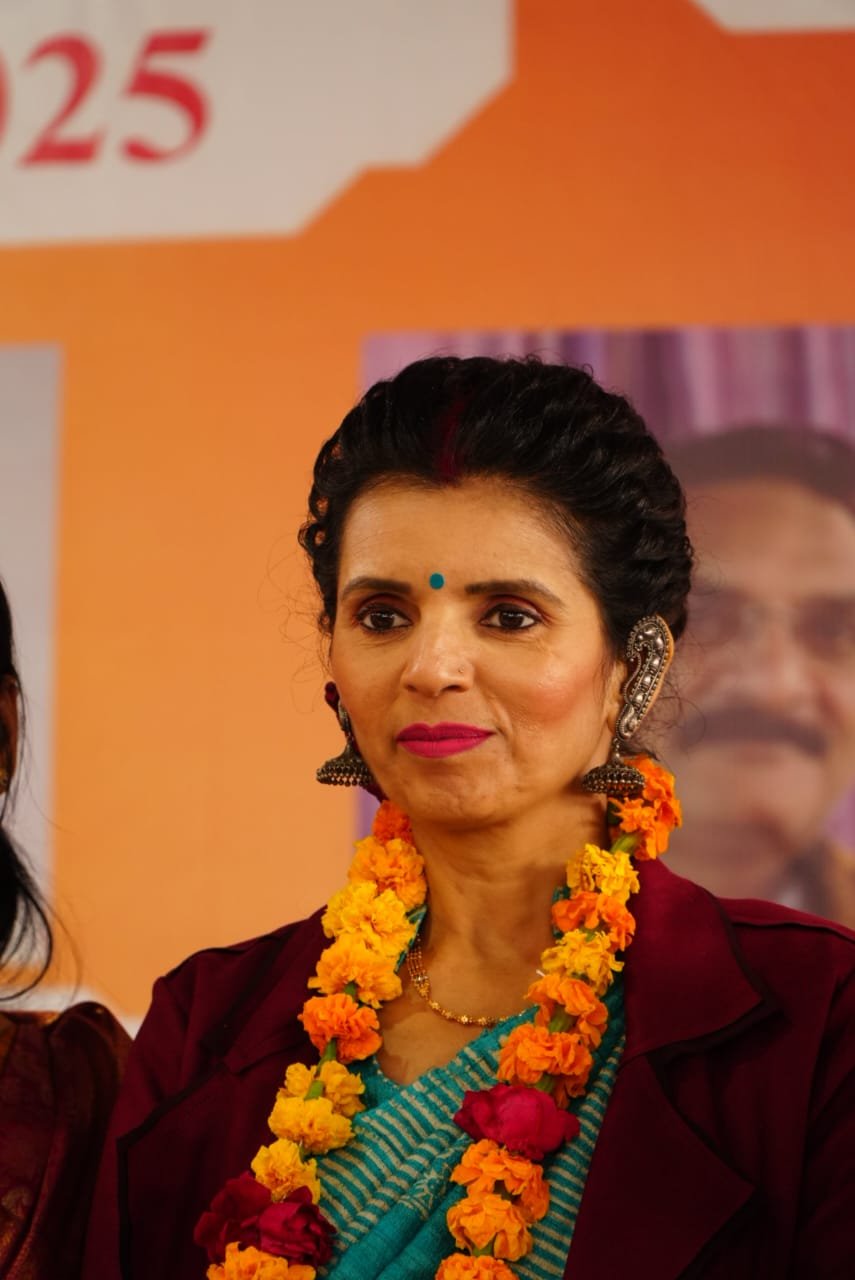
Long before there were cameras, there were storytellers. In every village of Bharat, under banyan trees and in temple courtyards, the katha vachak would sit with an audience gathered around him and narrate the Ramayana, the Mahabharata, the stories of the Puranas. He did not simply entertain. He transmitted dharma. He carried the wisdom of our rishis from one generation to the next, wrapped in emotion, music, suspense, and devotion. Children learned courage from Abhimanyu, patience from Sita, sacrifice from Karna, and righteousness from Yudhishthira, not from lectures, but from stories.
When I look at Indian cinema today, I see the same tradition wearing new clothes. The screen has become our katha mandap. The projector has replaced the oil lamp. And the question that has occupied me deeply as a producer, as the Chairperson of the Sanatan Sanskrutik Sangh, and simply as a daughter of this civilization is this: are we using this extraordinary instrument the way our storytelling tradition intended? Are we transmitting dharma, or merely transmitting noise?
This blog is my reflection on the journey of spiritual storytelling in Bollywood and Indian cinema where it began, where it wandered, where it is returning, and where I believe it must go.
Cinema in India Was Born Spiritual
It is worth remembering that Indian cinema did not begin with romance, crime, or comedy. It began with the divine.
In 1913, when Dadasaheb Phalke made Raja Harishchandra, the first full-length Indian feature film, he chose the story of a king who sacrificed everything his kingdom, his family, his own dignity for the sake of truth. Think about that choice. The father of Indian cinema, given a blank canvas and a revolutionary new technology, did not look to the West for his first story. He looked to the Puranas. He looked to satya and dharma.
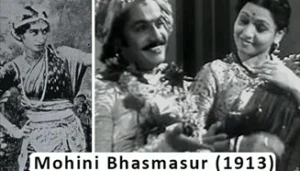
Phalke himself said he was inspired after watching a film on the life of Christ; he asked himself why Indians should not see their own gods, Krishna and Rama, on screen. His subsequent films Mohini Bhasmasur, Satyavan Savitri, Lanka Dahan, Shri Krishna Janma established what we can call the mythological genre, the very foundation stone of our film industry.
This was not an accident. It was civilizational continuity. For thousands of years, our performing arts, from the Natya Shastra of Bharata Muni to Ramlila, from Kathakali to Yakshagana, existed for one supreme purpose: to bring the human being closer to the divine. Bharata Muni described natya itself as the fifth Veda, accessible to all, created so that dharma, artha, kama, and moksha could be communicated through performance to every section of society. Indian cinema inherited this sacred DNA. Our first filmmakers were not merely businessmen; they were, knowingly or unknowingly, continuing the work of the katha vachak.
The Devotional Golden Age
The decades that followed deepened this current. The 1930s gave us Sant Tukaram (1936), a Marathi film so profound in its portrayal of the saint’s life that it won international recognition at the Venice Film Festival one of the first Indian films to be honoured abroad. The world, even then, recognized that India’s spiritual cinema carried something universal.
Films on Meerabai, Sant Dnyaneshwar, Narsi Mehta, and Kabir followed. These were not niche films for a religious audience. They were mainstream cinema. Families went together; villages gathered around touring cinemas. The bhakti movement, which had once travelled through the compositions of our sant kavis, now travelled through celluloid. These pioneering works laid the foundation for what we now celebrate as cultural films in Indian cinema, preserving India’s spiritual heritage while inspiring generations through meaningful storytelling.
Even as Hindi cinema diversified in the 1950s and 60s into social dramas and romances, the spiritual thread never disappeared. It simply moved into the music. Listen to the bhajans of that era: “Man Tadpat Hari Darshan Ko Aaj” from Baiju Bawra, composed by Naushad, written by Shakeel Badayuni, sung by Mohammed Rafi. Here were artists of different faiths coming together to create one of the most soul-stirring Hindu devotional songs ever recorded. This, to me, is the living proof of what I have always believed: Sanatan is not the property of one sect. It is the shared spiritual inheritance of this land, and cinema at its best has demonstrated that unity effortlessly.
And then came 1975, a year that tells us everything about the power of devotional cinema. The same year that gave us Sholay and Deewaar, two titans of commercial cinema, also gave us a modestly budgeted film called Jai Santoshi Maa. Made at a fraction of the cost, it became one of the biggest hits of the year. Women came to theatres with thalis, flowers, and diyas. Cinema halls became temples. Audiences removed their footwear before entering. The line between darshan and cinema dissolved completely. Whatever critics may have said, the message was unmistakable: the Indian audience’s hunger for the sacred had never gone away.
The Years of Drift
Yet I must speak honestly, because honest reflection is itself a Sanatan value. From the 1980s onward, mainstream Bollywood gradually drifted from this spiritual core. The mythological genre was pushed to the margins, considered old-fashioned, something for television rather than the big screen. Interestingly, it was television that proved the sceptics wrong: when Ramanand Sagar’s Ramayan and B.R. Chopra’s Mahabharat aired in the late 1980s, the streets of India emptied. Trains were delayed because passengers refused to board until the episode ended. An entire nation sat together, across languages and regions, watching its own civilizational epics. No “modern” content has ever achieved that scale of unity, before or since.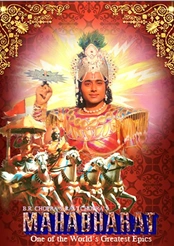
But in films, spirituality was increasingly reduced to a set piece: a temple scene before the climax, a bhajan inserted for convenience.Our classical ragas, which our musicians pursued for forty and fifty years as a path to Ishwar prapti, were replaced by imported electronic beats. Stories celebrating our sanskars gave way to stories imitating Western sensibilities. We began exporting our screens to foreign values instead of exporting our values to foreign screens.
I do not say this with bitterness, but with clarity. A civilization that forgets to tell its own stories will soon be living inside someone else’s story. And for a few decades, that is precisely what happened to us.
The Great Return: A New Spiritual Renaissance on Screen
But Sanatan means eternal, that which cannot be destroyed, only forgotten and remembered again. And what we are witnessing in Indian cinema over the past decade is nothing short of a remembering.
Look at the films that have shaken the box office and the national imagination. Baahubali retold the grammar of our itihasa the righteous prince, the rajmata, the dharma of kingship- and became a global phenomenon. Kantara, made in Kannada with deep roots in the Bhoota Kola tradition of coastal Karnataka, took a hyper-local spiritual practice and made the entire world feel the presence of the divine in its climax. Audiences across languages reported experiencing something they could not explain: goosebumps, tears, a sense of darshan. That is not cinema alone. That is Shakti finding a new medium.
Karthikeya 2 wove a thriller around Lord Krishna’s Dwarka and became a surprise pan-India hit. Films exploring our temples, our traditions, and our epics are being announced across every major production house. Regional cinema Kannada, Telugu, Tamil, Malayalam has led this renaissance with remarkable confidence, proving that rootedness is not a limitation but a superpower. The more local and authentic the spiritual element, the more universal its impact. This is a lesson Bollywood is now relearning from its southern siblings.
Why is this happening? Because the youth of Bharat is asking questions. They are no longer satisfied with borrowed identities. They want to know who they are, where they come from, what their festivals mean, why their grandmothers fasted, why their rivers are worshipped as mothers. Their growing interest is also reflected in the rising popularity of spiritual events in India, where traditions continue to inspire younger generations. When a generation begins asking such questions, it seeks answers everywhere, and cinema, the most powerful medium of our age, is answering.
My Own Journey: Cinema as Seva
I write about this subject not only as an observer but as a participant. After the difficult years of the pandemic, when many of our initiatives had to be rebuilt from the ground up, my husband and I asked ourselves a simple question: what is the most effective way to carry Sanatan values to the maximum number of people, especially the young, in a language they enjoy? The answer was cinema.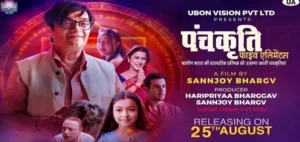
We produced a Hindi feature film built around Indian culture, spirituality, and human values five interconnected stories, each carrying a Sanatan ideal, told not as a sermon but as entertainment. Because I firmly believe this: values that are preached are resisted; values that are experienced through story are absorbed. That is the genius of our katha tradition, and it works on screen exactly as it worked under the banyan tree.
The film released across eleven Hindi-speaking states in nearly seven hundred theatres. But for me, the most meaningful part of the journey was not the numbers it was the intention behind the release. We made a special effort to reach single-screen theatres and rural audiences, the very people mainstream cinema often ignores. At every show, we offered gifts to three viewers a small gesture through which entertainment became a channel for tangible help and joy. Art and seva, walking together. Spirituality and cinema, walking together. This, to me, is the model: a film should not only tell a good story; it should do good while telling it.
That experience taught me something every filmmaker should internalize: the audience of Bharat is not cynical. It is thirsty. Give people a story that respects their intelligence and honours their roots, and they will embrace it with a devotion no marketing budget can buy.
The Responsibility Ahead
Cinema reaches where books do not. A film crosses the barriers of literacy, language, and geography in a single weekend. This power comes with responsibility, and I say this to every producer, writer, and director of our industry, including myself.
We must invest in authenticity. Bring scholars of the Vedas, Puranas, and our regional traditions into the writing room, so that our stories are not built on distorted translations and half-understood interpretations. Our scriptures are an ocean; too many films are content to splash in a puddle.
We must revive our classical music in film. Our ragas are a spiritual technology refined over millennia, each one designed to evoke a specific state of consciousness. A film industry sitting on this treasure and importing beats from abroad is like a man begging outside his own palace.
We must tell the stories no one has told. Beyond Rama and Krishna, whose stories must certainly continue, lie thousands of untold narratives: our sants and bhaktas from every region, our women of valor, the shared spiritual roots of Vaidik, Jain, Buddhist, and Sikh traditions that are all branches of one eternal tree. What a wealth of cinema is waiting there.
We must also embrace the new platforms wisely. OTT and digital media have placed a cinema hall in every pocket of Bharat. A short film, a web series, a thirty-second reel on the meaning of a shloka can today reach crores of young viewers before breakfast. The Sanatan Sanstha itself uses these very channels to spread awareness of our heritage, because the medium is neutral it amplifies whatever we feed it. If we do not fill these platforms with our authentic stories, others will fill them with distortions of our stories. The choice, and the opportunity, belongs to this generation of creators.
And we must take these stories to the villages. The real Bharat lives in its gaons. A spiritual renaissance that plays only in urban multiplexes is incomplete. Single screens, mobile cinemas, regional dubbing, community screenings the katha must reach every courtyard, as it always did.
Conclusion: The Eternal Story Finds Its Newest Voice
I often say that when the roots of a tree are strong, no storm can bring it down and when the roots of our culture are deep, no force can weaken our identity. For over a century, Indian cinema has been one of the great custodians of those roots, sometimes faithfully, sometimes forgetfully, but never finally abandoning them. From Raja Harishchandra to Kantara, the current of the sacred has flowed beneath our cinema like the Saraswati, sometimes visible, sometimes hidden, but always present.
Today, that river is rising to the surface again. A new generation of filmmakers is discovering what Dadasaheb Phalke knew in 1913: that the greatest stories of this land are the eternal ones, and the audience’s heart is still tuned to them. As Haripriyaa Bharggav, my prayer and my work are dedicated to ensuring that this renaissance grows deeper, more authentic, and more generous; that our screens become what our storytelling has always been: a lamp of dharma, passed from hand to hand, generation to generation.
The katha vachak has not disappeared. He has simply picked up a camera.
FAQs
1. What is spiritual storytelling in Indian cinema?
Spiritual storytelling in Indian cinema refers to films and narratives that convey values such as dharma, devotion, sacrifice, righteousness, compassion, and the connection between human life and the divine. It continues the ancient Indian tradition of katha vachaks who shared wisdom through stories.
2. How did spirituality influence the beginning of Indian cinema?
Indian cinema began with spiritual and mythological stories. Dadasaheb Phalke’s first Indian feature film, Raja Harishchandra (1913), was based on the ideals of truth and dharma, establishing a strong connection between cinema and India’s cultural heritage.
3. Which Indian films represent spiritual storytelling?
Several films have explored India’s spiritual and cultural traditions, including Raja Harishchandra, Sant Tukaram, Jai Santoshi Maa, Baahubali, Kantara, and Karthikeya 2. These films connect audiences with themes of faith, tradition, and moral values.
4. Why is spiritual storytelling becoming popular again in Indian cinema?
The renewed interest comes from audiences seeking authentic stories connected to their roots, traditions, and cultural identity. Modern filmmakers are exploring regional traditions, ancient wisdom, and spiritual themes through contemporary storytelling.
5. What role can cinema play in preserving Sanatan values and Indian heritage?
Cinema can preserve and share Indian heritage by bringing stories of saints, epics, traditions, and cultural values to a wider audience. Through films, digital platforms, and regional storytelling, timeless wisdom can reach new generations.