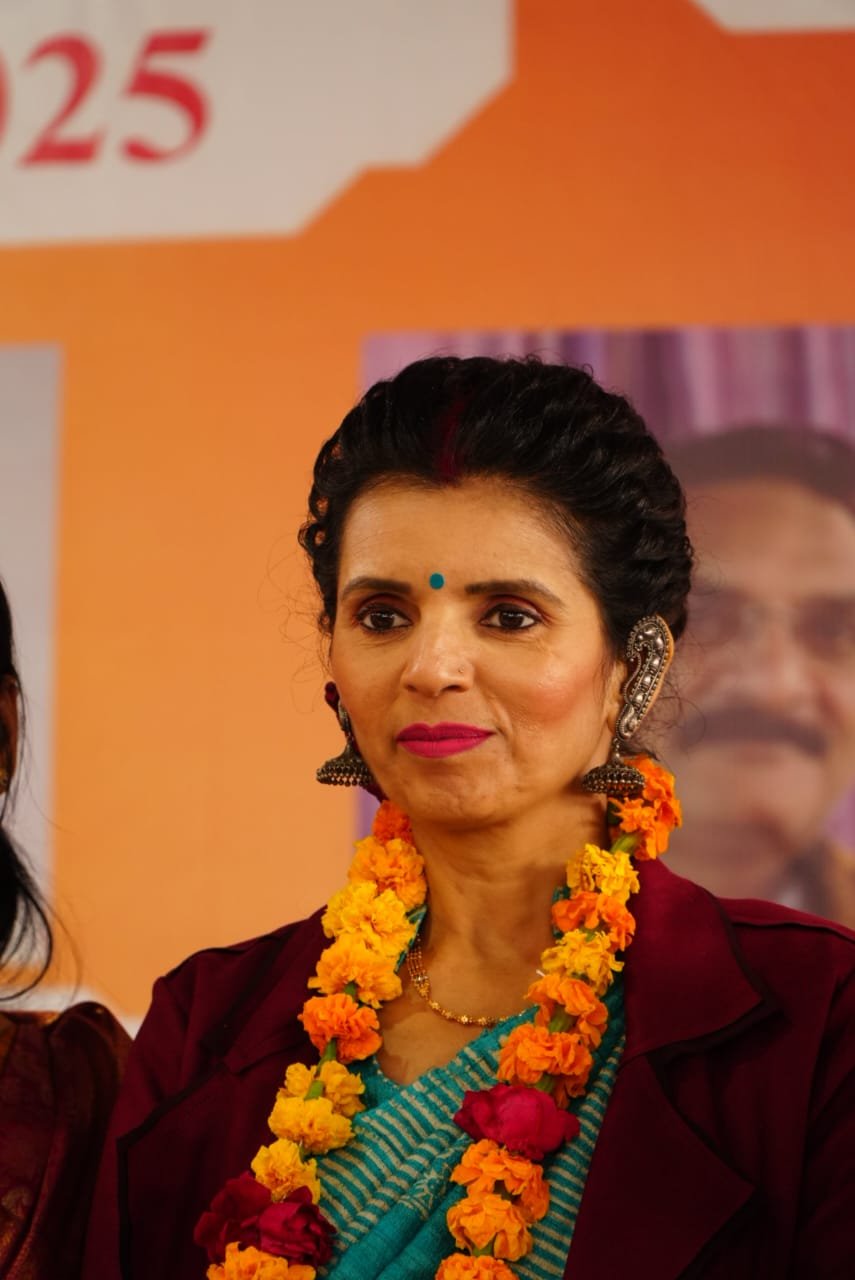
By Haripriyaa Bhargga
There is an old truth that should unsettle every Indian: a people who do not know their own story will always live inside someone else’s.
For generations now, we have been living inside a borrowed story. We were told that before the British arrived, India was poor, backward, and uncivilised, and that whatever light we have, we owe to those who conquered us. We absorbed this story so completely that we began to feel ashamed of our own inheritance. We started measuring ourselves by others’ standards, speaking others’ greetings, celebrating others’ festivals, and quietly forgetting who we were.
Sanskrutik Bharat is the movement to reclaim our own story.
As the third pillar of SSS Bharat, standing beside Samruddha and Samarth, Sanskrutik Bharat means a culturally rooted India: a nation that knows its own identity and makes its culture and values its greatest strength. It is a Bharat that has stopped living inside someone else’s narrative and has taken ownership of its own.
But let me be clear from the start about what this is not. Sanskrutik Bharat is not about rejecting the world, hating the modern, or retreating into the past. It is about something far more powerful: standing so firmly on our own roots that we can embrace the entire world without ever losing ourselves. This blog explains what that truly means and why preserving our cultural identity is the most urgent work of our generation.
The Root That Holds Everything
Let me begin with the image I return to in all my work, because it holds the entire meaning of Sanskrutik Bharat: the tulsi plant.
You can water its leaves every day. You can shield them from the sun, care for them, protect them. But if the root is weak, the leaves will keep falling no matter how much love you pour on them. The health of the whole plant lives, invisibly, in its root.
A civilisation is exactly the same. Its outer achievements its economy, its technology, its global standing are the leaves. Its culture is the root. And this is why Sanskrutik Bharat is not one pillar among three, but the pillar that holds the other two. Prosperity without cultural roots becomes exploitation. Empowerment without cultural roots becomes rootless imitation. Only when culture is strong do wealth and capability become sustainable, ethical, and truly ours.
Culture, in this deeper sense, is not costume or ritual for its own sake. It is the operating system of a confident people, the invisible foundation of values, wisdom, and identity from which everything else grows. When the root is strong, you can walk into any environment on earth and never lose yourself. When the root is weak, you dissolve into whatever surrounds you.
That is why preserving our cultural identity is not nostalgia. It is survival. It is the difference between a people who shape their future and a people who are shaped by others.
The Story We Were Told and the Truth We Forgot
To reclaim our identity, we must first confront the false story we were handed.
We were taught that India was a land of poverty and darkness until outsiders “civilised” us. But history, including the records of the very people who colonised us, tells a completely different tale. Before the British arrived, India controlled the largest share of the world’s wealth. We were the famous “Sone ki Chidiya,” the Golden Bird. When much of Europe was still in caves, our gurukuls were thriving centres of learning, open to students from every background.
Consider what actually came from this land. The very numbers the world counts with zero through nine were India’s gift to humanity; without zero, there is no mathematics, and without mathematics, no modern science. Our Sanskrit is recognised as among the most logically perfect languages ever created. Ayurveda was healing humanity for thousands of years before modern medicine existed. Our knowledge of astronomy, metallurgy, surgery, agriculture, and philosophy was, for most of recorded history, unmatched anywhere on earth.
This was not a backward civilisation waiting to be rescued. It was a sovereign civilisation that led the world.
So how did we forget? The decline was not accidental; it was a systematic deconstruction. Those who colonised us understood something profound: to rule a people permanently, you do not merely take their wealth; you take their story. You teach them that their traditions are primitive, their knowledge inferior, their identity a source of shame. Break the root, and the whole tree can be owned. And the most dangerous part of all is that we came to call this loss “modernisation.” We mistook the erasure of our identity for progress.
Sanskrutik Bharat is the reversal of that deconstruction. It is a people picking up their own story again, not out of arrogance, but out of the simple right to know who they are.
The Generation That Went Blank
Nowhere is this loss more visible, or more urgent, than in our young.
Ask a young Indian from Gen Z or Gen Alpha to follow a global trend, and they will master it in moments. They know the newest music, the latest apps, the trending styles from every corner of the world. But ask them about their own heritage, their scriptures, their true history, the depth of the Sanatan wisdom that shaped one of humanity’s greatest civilisations, and too often the answer is a single, painful word: blank.
Globalisation gave our youth the whole world, and in the exchange quietly took away their sense of self. They can navigate every culture except their own. They are fluent in everyone’s story but their own.
And we must say this with honesty and humility: this is not their fault. It is a values gap, and it was created by those who came before them. The responsibility to pass down our culture belonged to the parents, the elders, the earlier generations. Where that transmission failed, the chain broke. You cannot blame a young person for not knowing what was never taught to them.
This is what makes the Sanskrutik Bharat vision so urgent. A generation that does not know its roots will bend in every storm, chase every passing trend, and mistake imitation for identity. But a generation that knows its roots, that knows the greatness it comes from, walks through the world with a quiet, unshakable confidence. Preserving cultural identity, then, is really about giving our children back the strength that is their birthright.
Reclaiming Our Own Language, Our Own Greetings, Our Own Life
Cultural identity is not preserved only in grand declarations. It lives in the small, daily choices in the words we speak, the greetings we offer, the way we move through ordinary life. And it is here that we have surrendered the most without even noticing.
Take something as simple as a greeting. We say “Good Morning” a hundred times a day, rarely asking where it came from or whether it even fits us. In the lands where that phrase was born, the sun can vanish for months at a time, and its return truly is cause for celebration: “The morning is good, the sun has come!” But in Bharat, the sun has risen faithfully every single day for countless millennia. We have our own greetings, rich with our own meaning: Shubh Prabhat, Namaste, Jai Shri Krishna, Ram Ram. Our own language, our own greetings, our own pride.
This is not about rejecting a word out of hostility. It is about awareness, noticing how much of ourselves we have quietly handed over, and choosing, consciously, to reclaim it. When we return to our own greetings, our own festivals, our own languages, we are not going backward. We are coming home.
And here lies the heart of it. Sanskrutik Bharat does not ask us to hide from the world or to reject modernity. Our tradition never demanded that. We can progress, globalise, connect with people everywhere, and compete on the world stage. But we can do all of it without abandoning our roots, sitting at the global table while remaining fully, proudly ourselves. To live life the way our own wisdom teaches, while engaging freely with the world: that is the balance Sanskrutik Bharat seeks.
A Culture Wide Enough to Hold Everyone
There is a common misunderstanding I must address directly: that preserving our cultural identity means division, exclusion, or narrowing ourselves against others. The truth is the exact opposite. Our culture is one of the most inclusive the world has ever known.
At the heart of the Sanatan vision is the understanding that many spiritual streams flow from one eternal source. The Vedic, Jain, Buddhist, and Sikh traditions are all liberation-seeking; all moksha-lakshi are not rivals but reflections of the same timeless wisdom. Sanatan itself means that which is Anadi (without beginning) and Anant (without end), eternal, infinite, beyond the boundaries of time. A culture this vast does not shrink into sectarianism. It rises above the divisions of caste, creed, and varna to unite what was always meant to be one.
And its deepest principle is the most inclusive idea ever conceived: “Vasudhaiva Kutumbakam,” the world is one family. This is a culture whose highest teaching is not “we against them,” but “all of us together.” It honours Matru Shakti and Yuva Shakti, the power of women and youth. It reveres Gau, Ganga, and Gaon: the cow, the sacred rivers, the village. It teaches the protection of the Panch Bhuta, the five elements of nature, as a sacred duty. This is not a small or fearful identity. It is a civilisation generous enough to embrace the whole earth as kin.
So when we speak of preserving cultural identity, we are not building walls. We are restoring a light that was always meant to be shared with the world.
From Vision to Ground: How We Preserve and Revive
A culture is not preserved by admiring it from a distance. It must be lived, taught, and transmitted, especially to the young. And through the work of the Sanatan Sanskrutik Sangh, this preservation is happening in real, tangible ways.
At the foundation are the Vaidik Pathshalas, sacred centres of learning dedicated to the Vedas, Puranas, Sanskrit, and dharmic ethics. Their purpose is to ensure that the boundless knowledge of our tradition no longer remains locked away with a handful of scholars or filtered through diluted translations, but is returned to the people to whom it always belonged. This is the revival of our ancient gurukul spirit for a new generation, giving young minds not only knowledge, but pride in who they are.
But preservation must also meet the young where they already are. This is why cultural films and modern Indian storytelling, devotional music, and digital platforms carry our heritage into the language of screens and stories that this generation lives in. A Sanatan Song available across streaming platforms, feature films that weave our values into compelling narratives, and social media that reaches millions can turn culture from something studied into something felt. Reaching this generation means meeting them on their ground, then guiding them home to their roots.
Alongside this stand the great yatras, gatherings, and observances: the Sanatan Ekta Yatra, the Moksh Lakshi Sammelan uniting Gurus from every dharmic tradition, the collective celebrations that make heritage a living, shared experience rather than a museum piece. Each of these is an act of preservation: keeping the flame not merely alive, but bright and burning in the hearts of the people.
The practical wisdom I offer every parent and every capable person is simple: along with school fees, give values. Along with gadgets, give identity. Along with achievements, give wisdom. Providing our children accurate knowledge of Sanatan culture, Indian values, and our true history is every bit as essential as any degree because a successful person without roots is a hollow success, but a rooted one is unshakable.
The Invitation: From Passive to Active
Preserving a civilisation’s identity is not the work of a few institutions alone. It is the responsibility of every person who has been given something to give.
The crisis of our time is not that our culture lacks value; it is the gap between capability and action. Too many of us who know our heritage do not share it. Too many who have influence do not use it to protect our identity. Too many who could lead choose to stay silent, telling themselves, “This is not my concern.”
Sanskrutik Bharat answers that silence with an invitation: “Every capable person, every successful individual, every Sanatani is invited to transform from passive to active.” From nishkriya to sakriya. To preserve our cultural identity, each of us must become an active carrier of it in our homes, in how we raise our children, in the greetings we choose, the festivals we honour, the wisdom we pass on. Culture does not survive in books alone. It survives in living people who choose, every day, to carry it forward.
Coming Home to Ourselves
So what is Sanskrutik Bharat? It is a people coming home to themselves.
It is the end of living inside a borrowed story and the beginning of reclaiming our own. It is a nation that knows it was the Golden Bird, that gave the world its numbers and its languages and its ancient sciences, and that need never again feel ashamed before anyone. It is a generation given back its roots, and therefore its confidence. It is a culture wide enough to embrace the whole world as family, standing so firmly on its own ground that it can meet modernity as an equal rather than kneeling before it.
Preserving cultural identity is not about looking backward. It is about building forward with strong roots, so that no storm can uproot us. It is the quiet, deep foundation beneath a prosperous and empowered Bharat.
As I often say: “When the roots of a tree are strong, no storm can bring it down, and when the roots of our culture are deep, no force can weaken our identity.” This single truth is the whole meaning of Sanskrutik Bharat.
To every reader: you are not a footnote in someone else’s history. You are the living inheritor of a civilisation five thousand years in the making. Know your story. Honour your roots. Pass them on. Move from passive to active. Because a nation that knows who it is can never truly be conquered, and a people rooted in their own identity will stand tall through every storm the world can send.
That is Sanskrutik Bharat. And it begins the moment we choose to remember who we are.
Haripriyaa Bharggav is an entrepreneur, philanthropist, and cultural leader, and the Chairperson of the Sanatan Sanskrutik Sangh, a movement dedicated to reviving India’s cultural consciousness, empowering women and youth, and building a self-reliant, dharmic Bharat.