
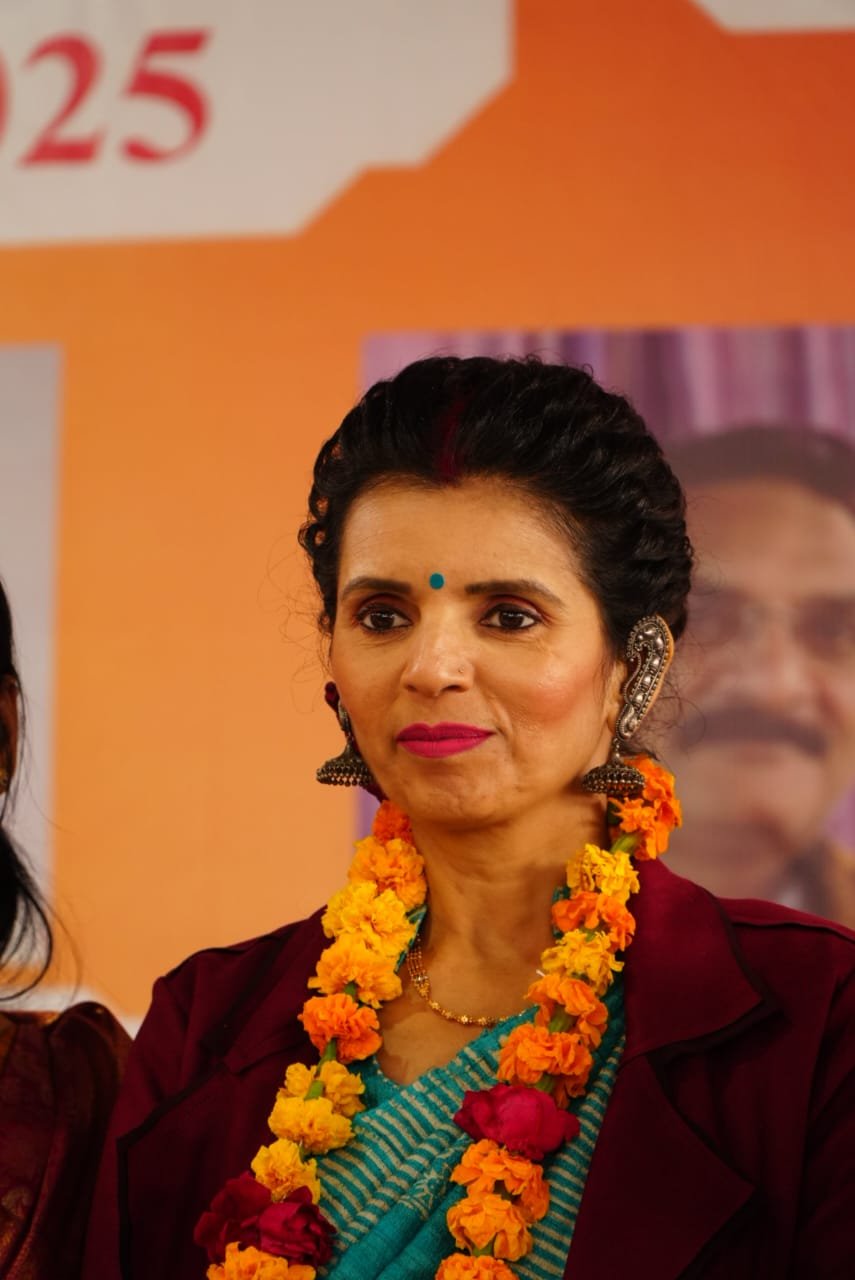
By Haripriyaa Bharggav, Entrepreneur, Film Producer, Philanthropist, and Chairperson, Sanatan Sanskrutik Sangh
Every civilisation survives through its stories. For thousands of years, Bharat transmitted its values through the Ramayana recited in courtyards, through Katha and Kirtan in village squares, through folk theatre, Ras Leela, Yakshagana, and Nautanki. The medium changed with every generation, but the message stayed constant: dharma, karma, seva, satya, and the idea that the individual exists inside a family, the family inside a society, and society inside nature itself.
Today that same role belongs to cinema.
India produces more films annually than any other nation on earth. A single film can reach more people in one weekend than a hundred conferences reach in a decade. When a young person in Lalitpur, Jhansi, or Bundelkhand watches a film, they are not simply being entertained; they are being told what success looks like, what a family looks like, what a woman’s strength looks like, and what is worth aspiring to.
That is an enormous responsibility. And right now, it is being under-used.
As an Indian entrepreneur and women film producer in India who has built businesses across eleven verticals from finance and media to real estate, technology, textiles, and film production, I have spent years watching how narrative shapes economics, and how economics shapes narrative. My conclusion is simple: Indian cinema is the single most efficient instrument available for the preservation of Indian culture, and it is the natural ally of the SSS Bharat mission.
The Crisis We Are Not Naming
Let me state the problem plainly, because vague diagnoses produce vague solutions.
Gen Z and Gen Alpha follow every global trend with extraordinary fluency. Ask them about a streaming series from another continent, and they can narrate the plot, the cast, the fan theories. Ask them about their own sanatan parampara, their own Vedic heritage, the meaning of the rituals in their own home, and there is silence.
This is not their failure. It is ours.
The responsibility of transmitting sanatan culture to the next generation belonged to Millennials and Gen X. We were the generation that had access to both worlds we could read the shlokas, and we could read the market. But somewhere between the school fee and the smartphone, we handed our children everything except identity.
This is not a generation gap. It is a values gap, and we created it.
Globalisation gave us the world and quietly took our reflection. The challenge before us is not rejecting modernity, but preserving Sanatan Sanskriti and Indian traditions while embracing progress. And the most dangerous part of this crisis is that we have normalised it. We call cultural erosion “modernisation.” We call dependency “progress.” We celebrate achievements built on borrowed foundations and mistake the illusion for prosperity.
Cinema did not cause this. But cinema can correct it because cinema is the only medium that reaches the child before the textbook does.
What SSS Bharat Means And Why Cinema Belongs Inside It
SSS Bharat is my vision of a nation resting on three pillars: Samruddha Bharat, Samarth Bharat, and Sanskrutik Bharat. Prosperous. Capable. Cultured.
SSS Bharat is my own mission and my own initiative, a personal sankalp, not the programme of any organisation. It is a sanatan cultural movement committed to Hindu heritage preservation, dharmic unity, rural development in India, women empowerment in India, and youth empowerment in India, without dividing our moksha-lakshi traditions Vedic, Jain, Buddhist, Sikh by caste, varna, or sect.
I also serve as Chairperson of the Sanatan Sanskrutik Sangh, and that work runs alongside this vision. But SSS Bharat is mine to carry. It began as a conviction, and it will stand or fall on whether people like you choose to make it theirs as well.
But here is the crucial point, and it is the one most often missed.
SSS Bharat is not a right-wing project or a left-wing project. Our Bhartiya Sanatan Shashvat Parampara never organised itself along imported ideological wings. Those categories were implanted from outside. Our tradition concentrated on one thing only: the people of the nation, their Atmik, Sharirik, Manasik and Arthik unnati spiritual, physical, mental, and economic advancement.
India is not a party-based nation. India is a democratic nation. Policies should serve the country, not implant a philosophy onto it. Fifty years ago we suffered from one extreme; today we suffer from another. A nation as diverse as ours cannot be governed by a single wing it requires a consolidated perception, a merger of what works, applied differently in different contexts.
Cinema, when it is honest, does exactly this. It does not argue ideology. It shows a life, and lets the viewer arrive at the truth themselves. That is why film is the perfect vehicle for a movement that refuses to be tribal.
Prevention Is Cheaper Than Cure, And Culture Is No Exception
The most important principle guiding my work in socio-economic development comes from our own healing tradition, and it applies to a civilisation exactly as it applies to a body.
Every serious intervention must move through three stages: preventive, supportive, curative.
Consider an antibiotic. You know it will strain the liver. So before you take it, you take something to protect the liver, which is prevention. Alongside it, you take nourishment that helps the body absorb the treatment that is support. Only then does the cure work without generating a second disease. Skip the first two, and you may clear the infection, but you will spend the next decade treating what the treatment caused.
We have inverted this entirely in almost every field. We build first and think about consequences later. We industrialise and then discover the river is gone. We chase yield with chemicals and then discover the food itself has become the problem. We dig the well after the fire has started.
Cultural loss follows the same pattern, only more quietly. Nobody announces the day a family stops speaking its own language at home, or the year a village stops performing its own festival properly. There is no emergency, no headline, just a slow erosion that we notice only when a whole generation cannot answer a simple question about who they are. By then we are in the curative stage, spending enormous effort to revive what cost almost nothing to maintain.
Prevention, in cultural terms, is transmission. It is the grandmother’s story, the shloka learnt before its meaning is understood, the festival performed with actual participation rather than photographed. It costs very little, and it works permanently.
Support is everything that makes that transmission survive contact with modern life: economic opportunity in the village so the family does not scatter, dignity attached to traditional knowledge so the young are not embarrassed by it, and media that reflects the culture back to people as something living rather than something quaint.
Cure is what we are left with when the first two are neglected: campaigns, revivals, restoration projects, and the exhausting work of persuading people to reclaim something they were never given.
This is where cinema enters, and it is why I take film seriously as a business and as a duty. Cinema is one of the few instruments capable of operating at the preventive and supportive stages simultaneously. It reaches the child before the erosion begins, and it reaches the adult who has already drifted, at the same time, in the same frame. No conference does that. No policy does that.
The question I ask of any film I am involved with is simply this: is it treating a symptom, or is it preventing the disease?
Six Ways Indian Cinema Can Actively Preserve Cultural Heritage
1. Restore the True History Before Someone Else Writes It
Before British colonisation, India held one of the largest shares of global GDP. Economic historian Angus Maddison’s estimates place India at roughly a quarter of the world economy around 1700. We were renowned for textiles, steel, shipbuilding, agriculture, and craftsmanship. When parts of Europe were still primitive, our gurukuls were flourishing centres of learning.
That prosperity is precisely why India became a destination for conquerors. Where there is wealth, predators arrive. What followed was not accidental decline; it was a systematic deconstruction of indigenous systems through punitive taxation and the deliberate dismantling of local production.
Cinema must tell this story properly. Not as grievance, but as fact. Because a people who do not know their own legacy will live inside somebody else’s narrative and eventually, inside somebody else’s economy.
Historical cinema, documentaries, and cultural film production are our defence against a distorted record. This is indian civilization told by Indians.
2. Make the Village Aspirational Again
I believe with total conviction that the real strength of a developed India lives in its developed and secure villages.
Today people leave the village out of compulsion. My aim, through the village development programs and total village development work I have taken up under Sanatan Sanskrutik Sangh, is to build atmanirbhar and sanskarit villages so that people return by choice and with pride, not by failure.
Cinema has enormous power here. For decades, our films have coded the city as arrival and the village as escape. Reverse that coding, and you begin to reverse migration itself. Show self-reliant rural enterprise. Show grassroots development that works. Show sustainable rural development in India as a life worth choosing.
Rural transformation in India begins as an image before it becomes an economy.
3. Portray Women as Shakti, Not as Statistics
India’s civilisational position on women was never in doubt: यत्र नार्यस्तु पूज्यन्ते रमन्ते तत्र देवता, where women are honoured, the divine resides.
Rani Lakshmibai led an army. Ahilyabai Holkar ran an empire. These are not exceptions; they are expressions of a worldview.
Women film producers in India and women leaders in the entertainment industry carry a specific duty here to portray Matru Shakti with depth rather than decoration. Not the woman who wins by becoming something else, but the woman whose power flows from what she already is. This is what genuine women’s empowerment India looks like on screen, and it is far more persuasive than any slogan.
4. Encode Financial Wisdom Into Story
Our Rishis gave a sustainable formula for personal economy thousands of years ago: 25% necessity, 25% saving, 25% donation, 25% luxury.
Notice what is built into it: donation is structural, not optional. Prosperity in our tradition was never private accumulation. It was circulation.
Today we celebrate lifestyles funded by borrowed money and call it success. That is not wealth; it is a facade. Cinema currently glamorises exactly this facade. It could instead make balanced prosperity aspirational, showing economic empowerment India as something built, shared, and sustained rather than displayed.
This is the foundation of Samruddha Bharat: a nation that extends its hand to no one.
5. Make Environmental Dharma Visible
Environmental consciousness is not an imported Western concept. It is the most ancient core of Sanatan philosophy: the protection of the Panch Bhuta: Prithvi, Jal, Vayu, Akash, Agni.
Plastic in the water damages Jal. Emissions damage Vayu. Deforestation renders Prithvi barren. Energy misuse unbalances Agni. These elements are one interconnected system; damage one, and all are damaged.
The Isha Vasya Upanishad instructs us to enjoy with renunciation, to use without exhausting, to leave something for those who come after. Cinema can dramatise this far more effectively than any policy document. A film that makes ecological responsibility feel like dharma rather than obligation changes behaviour permanently.
6. Teach Anekantavad: The Antidote to a Fractured Age
Ninety per cent of household conflicts arise from linguistic and contextual dissonance: two people describing the same reality through different frameworks and each believing the other is lying.
A mother strikes her child. From one perspective: harsh. From another: protective. The complete truth emerges only when you see multiple dimensions.
Anekantavad, the multiplicity of perspectives, is one of the most sophisticated conflict-resolution philosophies humanity has produced, and it is ours. Incomplete knowledge produces incomplete judgment, and incomplete judgment breaks homes and breaks nations.
Cinema is uniquely built for this. Show the same event from two viewpoints and the audience feels the lesson rather than being lectured. Words divide. Wisdom unites.
Cinema, Film Production, and the Business Case
I want to address a practical objection, because I am a businesswoman before I am anything else and I have no patience for arguments that ignore economics.
Cultural cinema is often assumed to be commercially weak. That assumption is outdated.
Audiences globally are hungry for authenticity. Rooted, specific, culturally confident storytelling travels further than imitation, because imitation is always inferior to the original. Copying another civilisation’s aesthetic is a signal of insecurity, and audiences sense it.
A spiritual film or cultural film producer working with genuine conviction is not making a charitable product. They are making a differentiated one. Modern Indian cinema producers who understand this will find that heritage is not a constraint on the market it is the moat.
Digital accessibility compounds this. Films, music, short-form reels, and social platforms now allow dharmic education and cultural awareness to reach a village in Bundelkhand as easily as a metro apartment in Mumbai. The distribution problem that limited cultural transmission for a century has been solved. What remains is the will to use it.
The Call to Action: From Nishkriya to Sakriya
“प्रत्येक सक्षम, प्रत्येक सफल, प्रत्येक सनातनी को आमंत्रण है निष्क्रिय से सक्रिय बनो।”
Every capable person, every successful individual, every Sanatani is invited to transform from passive to active.
You have resources, but you are not directing them toward society. You have knowledge, but you are not sharing it. You have influence, but you are not leading with it. You have capability, but you are staying silent.
This gap between capability and action is the crisis of our time.
To filmmakers, writers, producers, and creators: your frame is a classroom whether you intend it or not. Choose what you are teaching.
To parents: alongside school fees, give sanskar. Alongside gadgets, give identity. Alongside achievements, give values.
To every social entrepreneurship in India, every business leader, every humanitarian entrepreneur with the means to act, transformation always begins from within. Revive yourself first, then revive the generation.
Conclusion: Roots Before Branches
Cinema will continue to shape India whether or not we take it seriously. The only question is whether it shapes us toward our own centre or away from it.
SSS Bharat, the mission I have taken upon myself, exists to make that choice deliberate to build a Bharat that is Samruddha, Samarth, and Sanskrutik, grounded in Matru Shakti, Yuva Shakti, Gau, Ganga, Gaon, protection of the Panch Bhuta, and the living practice of Vasudhaiva Kutumbakam.
Know the past to build the future, and live the present consciously. That is not nostalgia. That is strategy: preventive, supportive, and curative, in that order.
“When the roots of a tree are strong, no storm can bring it down, and when the roots of our culture are deep, no force can weaken our identity.” Haripriyaa Bharggav










1 Comment
Rise of Women Founders in India’s Startup Ecosystem
[…] cultural and heritage-based entrepreneurship is likely to grow as a distinct category. As globalization accelerates and younger […]