
There is a question worth sitting with before reading any further.
If someone asked you today what India’s greatest strength is, what would you say? Its GDP growth rate? Its young population? Its technology sector? Its defence capability?
All of these are real. All of these are measurable. And all of them are, in a sense, borrowed metrics frameworks handed to us by an external world that decided what counted as “development” and asked us to compete on that scoreboard.
SSS Bharat asks a different question entirely: what if the scoreboard itself needs rewriting?
SSS Bharat stands for a vision of a nation that is Samruddha (prosperous and economically sovereign), Samarth (capable and empowered), and Sanskrutik (culturally rooted and conscious of its identity).
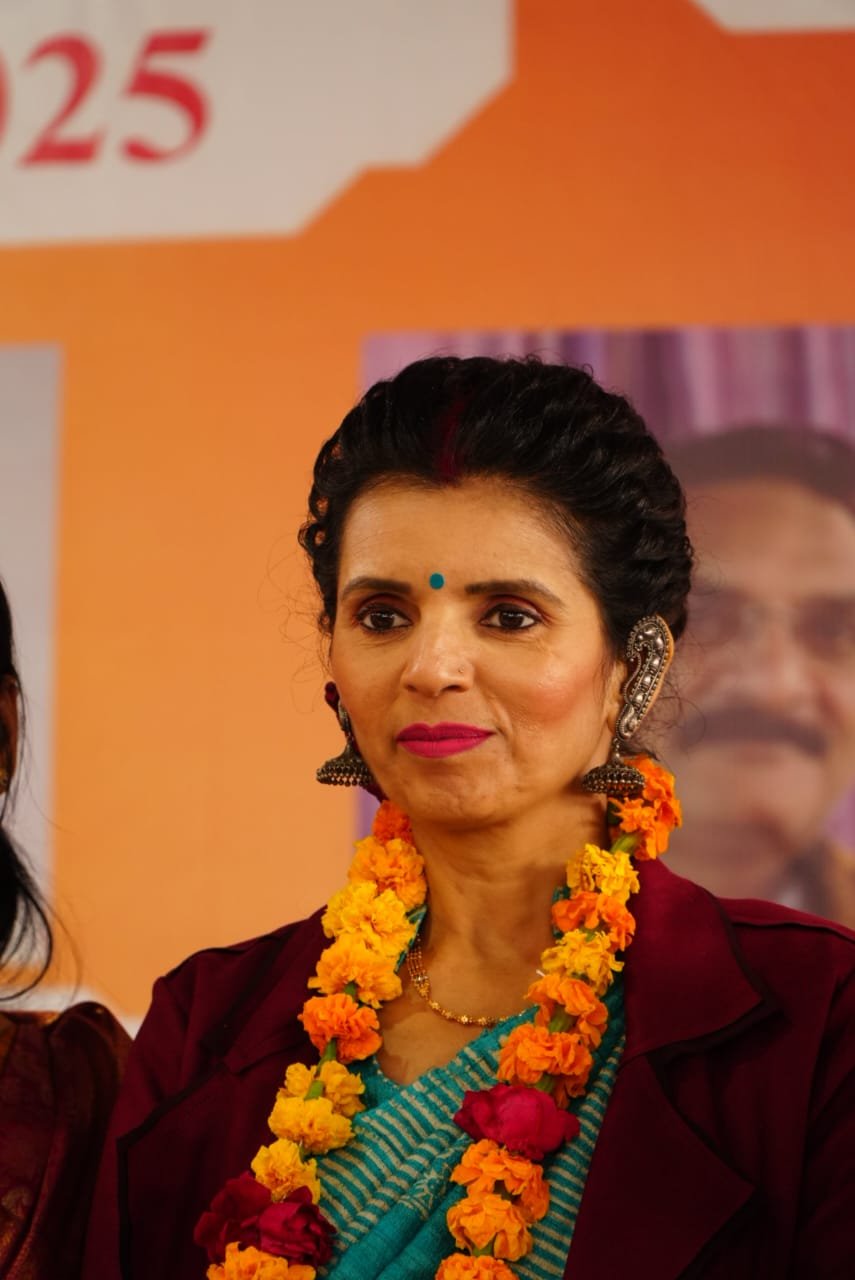
It is the guiding framework of the Sanatan Sanskrutik Sangh, led by entrepreneur, philanthropist, and cultural activist Haripriyaa Bharggav a daughter of Bundelkhand who built a business empire across eleven verticals from Mumbai, but whose commitment has stayed anchored in the soil of Jhansi and Lalitpur.
Her journey also reflects the growing influence of women business leaders India has witnessed in recent years women who are not only building successful enterprises but also contributing to social transformation, cultural preservation, and community development.
This is not a slogan. It is a diagnostic framework, a development philosophy, and a call to action rolled into three Sanskrit words.
Let’s unpack each one.
Why India Needs a New Development Framework
Before the pillars, the premise.
Every serious conversation about India’s future eventually runs into the same wall: we are executing policies designed for a different civilisation. Our geological data is different. Our population density is different. Our climate, our family structures, our faith systems, our emotional and social frameworks are all different.
And yet the policy templates, the education systems, the urban planning models, the economic indicators are largely imported.
The result is what any doctor would recognise instantly as bad medicine: we are treating symptoms without prevention, and we’re surprised when side effects multiply.
The Preventive–Supportive–Curative Principle
One of the most powerful ideas underpinning the SSS Bharat philosophy comes from Ayurvedic thinking applied to nation-building. Consider how modern healthcare works versus how traditional Indian systems worked.
If you take a strong antibiotic, you know it will stress the liver. So a wise practitioner does three things: gives you something preventive before the damage begins, something supportive to help the body cope, and only then something curative to fight the illness itself.
Now apply that to national policy.
Before any infrastructure project, any economic strategy, any social programme the question should be: what are the second-order effects, and what have we put in place to absorb them? Instead, we routinely skip straight to curative. We wait for the fire, then look for water.
The traditional approach would be different: dig the well before the fire is possible. Run a channel underground so the area stays cool. Then, even if fire breaks out, containing it is straightforward.
This is not romantic nostalgia. It is systems thinking, the kind that treats a nation as a living body rather than a machine to be optimised.
Look at what happens when we skip the first two stages. Agriculture without preventive soil care, without supportive organic systems, just steroids and chemicals dumped in for yield. Yes, production rose. But what came out the other end? Food or slow poison? Yields went up while soil health, water tables, and farmer wellbeing collapsed. That is curative-only thinking, and its bill always arrives.
The same pattern repeats across terrorism, poverty, wealth concentration, environmental collapse, and generational alienation. We anticipate nothing. We prevent nothing. We support nothing. Then we throw enormous curative resources at problems that had been visible for decades.
SSS Bharat is, at its foundation, an argument for anticipatory nation-building. We may not know exactly when a crisis will come or what form it will take, but we can anticipate its category and build resilience in advance.
Beyond Left Wing and Right Wing
There’s a second premise worth stating clearly, because it’s frequently misunderstood.
The framework of “right wing” versus “left wing” is not indigenous to Indian civilisational thought. Our Sanatan and Shashvat traditions never organised themselves along that axis. They concentrated on the people of the nation, their Atmik (spiritual), Sharirik (physical), Manasik (mental) and Arthik (economic) advancement.
A nation as diverse as India cannot be governed by a single imported ideology. In a country of this complexity, expecting uniform mentality is unrealistic and undesirable. What’s needed is merger, not monopoly, taking what genuinely serves the nation from every direction and consolidating it.
The private sector needs growth. Simultaneously, the vast population outside it needs meaningful work. These are not opposing demands requiring you to pick a side; they are two requirements of one balanced system.
Consider the medical analogy again. If cholesterol rises, you don’t just administer a cholesterol drug and walk away. You watch that the kidney vessels don’t weaken. You consider a blood thinner but not so much that a minor cut becomes dangerous. Balance is the entire discipline.
India is not a party-based nation. It is a democratic nation. Parties should adapt their philosophy to what serves the nation, rather than implanting their philosophy onto the nation. Fifty years of damage from one direction followed by damage from the other direction leaves the country in permanent turmoil swinging between extremes rather than building steadily.
“For the people, by the people, of the people” that is the constitutional principle. The question worth asking is whether the people are actually present in the equation, or whether only the parties are.
That is the ground SSS Bharat stands on. Now, the three pillars.
Pillar One: Samruddha Bharat: An Economically Sovereign India
Samruddha means prosperous. But the word carries more weight than “rich.”
Samruddha Bharat is a nation where every citizen is genuinely self-reliant (Atmanirbhar), where the country is economically sovereign, and where, in the simplest possible framing, we don’t have to extend our hand to anyone.
The Reality Check: We Were Once the Wealthiest Civilisation on Earth
This isn’t sentiment. It’s economic history.
According to economic historian Angus Maddison’s widely cited estimates, India held roughly 24–27% of global GDP around the year 1700, among the largest economies in the world. India was globally renowned for its textile industry, steel production, shipbuilding, agriculture, and handicrafts.
When large parts of Europe were still developing basic infrastructure, India had functioning gurukuls, thriving trade networks, and sophisticated knowledge systems. This is documented history, not mythology.
We were called Sone ki Chidiya, the Golden Bird for a reason. And here is the uncomfortable corollary that we rarely state plainly: wealth attracts predators. The sheer number of conquerors and empires that made India their destination was not a coincidence. It was strategy. Where there is wealth, there are those who come to take it.
The Systematic Deconstruction
India’s decline was not accidental drift. Colonial policies imposed heavy duties on Indian industries, deliberately weakened local production, and dismantled indigenous economic systems. Trade networks were broken. Knowledge systems were disrupted. An economy that had fed and clothed much of the world was reoriented to serve someone else’s.
But here’s the part that matters most for today:
The most dangerous outcome wasn’t the dependency itself. It was that we began calling that dependency “modernisation.”
We celebrate progress built on borrowed money. We measure development in terms of how closely we resemble economies that were, for centuries, considerably behind ours. That is not prosperity. That is a well-decorated illusion.
What Samruddha Bharat Actually Looks Like
The path forward is Swavalamban genuine self-reliance, not slogan-level self-reliance.
And critically, it runs through the villages.
Here is a distinction worth internalising: India never historically differentiated between “urban” and “rural” as separate categories of citizen. That division is itself an imported administrative construct. Bharat was Bharat. The smallest person in Bharat was considered as much a part of its prosperity as the largest.
Today, people leave villages for cities out of compulsion. The goal of Samruddha Bharat is to build villages that are prosperous, cultured, and self-sufficient so that people return by choice and with pride, not by failure and retreat.
The real strength of a Viksit Bharat lives in developed and secure villages. Rural development isn’t charity or a welfare line item. It is the actual load-bearing structure of national prosperity.
Financial Literacy: The 25-25-25-25 Formula
Personal economics is national economics at scale. And without financial literacy, no income level produces genuine prosperity.
Money has four dimensions: Expenditure, Saving, Donation, and Luxury. When any one dimension becomes extreme, personal economies collapse, and enough collapsed personal economies produce a collapsed national one.
Our Rishis articulated a sustainable formula millennia ago:
- 25% Necessity
- 25% Saving
- 25% Donation
- 25% Luxury
Notice what’s built into it. Donation is not an afterthought or a tax-saving exercise; it’s a structural quarter of the model. Luxury isn’t demonised; enjoyment is permitted, but bounded. Saving isn’t heroic sacrifice; it’s routine.
This is not merely financial advice. It is a holistic philosophy of balance, and it applies as much to a nation’s balance sheet as to a household’s. Genuine wealth is balanced wealth. Prosperity displayed on borrowed money is a facade.
Pillar Two: Samarth Bharat: An Empowered and Capable India
Samarth means capable. Empowered. Standing firm under one’s own strength.
Samarth Bharat envisions a nation of young people who are connected to their roots, who make conscious choices rather than reflexively following global trends, and who understand their identity well enough to use it as a source of strength rather than a source of embarrassment.
It means activating and honouring Matru Shakti (mother power) and Yuva Shakti (youth power), the two forces that actually shape what a civilisation becomes.
It means activating and honouring Matru Shakti (mother power) and Yuva Shakti (youth power), the two forces that actually shape what a civilisation becomes. Strengthening Matru Shakti is not only about recognising women’s contributions but also creating opportunities where women can lead, innovate, and transform communities. Across India, various women empowerment rural India initiatives are demonstrating how empowered women become catalysts for social and economic progress.
The Crisis Nobody Wants to Name
Ask Gen Z or Gen Alpha about any global trend, and you’ll get a fluent, detailed, up-to-the-minute answer. They track the world in real time.
Ask them about their own culture. About the philosophical traditions their great-grandparents lived by. About the actual history of the land they stand on.
Often: blank.
Globalisation gave us the world. In the exchange, we quietly handed over our identity.
But let’s be precise about accountability here, because it’s tempting and inaccurate to blame the young.
The responsibility of transmitting our culture and values to Gen Z and Gen Alpha belonged to Millennials and Gen X. That transmission largely didn’t happen. This is the generational failure at the heart of the crisis, and it isn’t the fault of children who were never taught.
It’s Not a Generation Gap It’s a Values Gap
This distinction is important.
We speak of “generation gaps” as though they were natural, inevitable, almost geological. They aren’t. What actually opens up between generations is a values gap, and it opens because of choices made by the older generation, not the younger.
When parents themselves compromise on their values, what role model are children supposed to follow? A child who watches adults treat principles as negotiable learns exactly that lesson, and learns it thoroughly.
Which leads to the uncomfortable and liberating conclusion:
If you want to revive a generation, revive yourself first. Transformation always starts from within.
What Samarth Bharat Requires From Us
The action is not abstract. It is domestic, daily, and specific:
- Along with school fees, give sanskar. Education without values produces capability without direction.
- Along with gadgets, give identity. A child fluent in devices but blank about who they are is not equipped.
- Along with achievements, give values. Accomplishment without an ethical frame is just accumulation.
In an age of globalisation, transmitting accurate knowledge of Sanatan culture, Indian values and true history to the new generation is not optional enrichment. It is foundational infrastructure.
The Commitment Question
One symptom of the values gap deserves specific attention, because it shapes the next generation’s entire social structure: commitment phobia.
The prevailing narrative is seductive: no responsibility, no adjustment, just convenience. And there is genuine freedom in it. That’s not in dispute.
But marriage, in the Indian framework, was never a contract of convenience. It was a profound partnership that comes with accountability, a sanskar, not an arrangement. Considering another person’s perspective, adjusting to it, carrying weight for someone else: these are not weaknesses. They are emotional maturity.
The core distinction is linguistic and revealing: in a purely convenience-based arrangement, there is yours, and there is mine. The concept of “ours” never actually forms. And “ours” is precisely what builds families, communities, and eventually nations.
Commitment without accountability isn’t a relationship. It’s a temporary arrangement. And the cost of an entire generation avoiding commitment is not paid by individuals it’s paid by society.
Anekantavad: The Antidote to Judgment
Samarth also means capable of thinking well, and here Indian philosophy offers something extraordinarily relevant to a polarised digital age.
Anekantavad, the doctrine of multiplicity of perspectives, holds that no truth is absolute and every viewpoint is partial. Complete truth emerges only when you examine multiple dimensions.
Take the classic illustration: a mother slaps her son. From one perspective, it is abusive. From another, protective. Neither observer is lying. Both are seeing a fragment.
We do this constantly. We judge someone from a single moment and define their entire personality from it. That is not judgment; that is cognitive bias wearing judgment’s clothes.
Extend this to national and global conflicts. Is this country wrong? Is that leader wrong? Usually the more accurate answer is that the circumstance is wrong. The person who fixes the situation solves the problem. The person who judges the individual perpetuates the conflict.
Incomplete knowledge produces incomplete judgments, and incomplete judgments break homes and break nations.
There’s a related insight worth knowing, because it explains an enormous proportion of everyday conflict. Sanskrit philosophical tradition distinguishes between Vyavahar Bhasha (pragmatic, colloquial speech) and Nishchay Bhasha (absolute, precise speech).
Saying “Jaipur aa gaya” is technically incorrect, since Jaipur didn’t travel toward you. But contextually, everyone understands perfectly. “Jaipur pahunch gaya” is the precise formulation.
A remarkable share of domestic conflict arises from exactly this linguistic dissonance two people describing the same reality through different frameworks, each convinced the other is wrong. As the Gita indicates, without a nuanced understanding of truth and untruth, there is no liberation from rigid dogma.
Words divide. Wisdom unites.
Pillar Three: Sanskrutik Bharat: A Culturally Rooted India
Sanskrutik means cultural. The third pillar envisions a nation that knows its own identity and treats its culture and values as its greatest strategic asset rather than a museum exhibit.
Whoever Doesn’t Know Their Legacy Lives in Someone Else’s Narrative
This single line contains the whole argument.
A civilisation that has forgotten its own history doesn’t become neutral. It becomes a resident of a story written by someone else, accepting their categories, their timelines, their assessment of what was primitive and what was advanced, their verdict on which of its own traditions to be proud of and which to quietly hide.
Sanskrutik Bharat means reclaiming narrative ownership. Not by inventing glory, but by knowing the documented record, including the reasons for the downfall, which are as important as the reasons for the greatness.
Environmental Consciousness Was Always Ours
Here is a live example of narrative reclamation.
Environmental consciousness is routinely presented as a progressive Western import, a modern ethical upgrade India is receiving from more enlightened quarters.
It is nothing of the sort. Protection of the five elements is the most ancient core of Sanatan philosophy.
Prithvi (earth). Jal (water). Vayu (air). Akash (space). Agni (fire). Ecological responsibility toward these five is documented in our scriptures thousands of years before “sustainability” became a corporate department.
And the diagnosis maps perfectly onto today’s crisis:
- Plastic discarded, water contaminated.
- Pollution accumulated; air turned toxic.
- Forests burning, energy squandered; fire element destabilised.
- Deforestation and soil degradation: earth turned barren.
It is an interconnected ecosystem. Damage one element and every other element registers the injury.
Climate change is not a foreign agenda. It is our most relevant ancient responsibility, restated in modern vocabulary. Whoever protects the five elements is an authentic Sanatani. Panch tatvon ki raksha karna hamara paramo dharma hai.
Notably, at the 1997 Kyoto discussions, serious scientific minds observed that civilisational philosophies which frame nature as something to live with rather than something to conquer offer a fundamentally different foundation for ecological policy. India’s philosophy was never “conquer nature.” It was always “live with nature.”
The Joint Family as an Economic System
Another reclamation, and a counter-intuitive one.
The joint family is typically discussed as tradition, sentiment, or nostalgia. That framing badly undersells it. The joint family was a robust, self-sustaining economic model.
The equation is straightforward: Joint family = shared resources + shared wisdom + shared responsibility.
Consider what it actually provided. Multiple income streams into one pool. Elder-care and childcare without paid external services. Skill transmission across generations at zero cost. Risk distributed across many shoulders instead of concentrated on one earner. Housing efficiency. An automatic safety net requiring no institution to administer it.
When that structure was dismantled, the consequences were economic, not merely emotional. Unemployment rose because the informal economy of family enterprise contracted. Insecurity rose because the safety net vanished.
Today’s nuclear household: single income, multiple pressures, zero safety net with every individual structurally isolated.
Nuclear family arrangements delivered genuine individual freedom. That gain is real. But the question worth asking honestly is: where did collective resilience go?
Collective strength is sustainable strength.
Unity Across Traditions
Sanskrutik Bharat is explicitly inclusive in its conception of Sanatan Dharma. The Sanatan Sanskrutik Sangh works to unite Vedic, Jain, Buddhist, and Sikh all moksha-oriented dharmic traditions, rising above distinctions of caste and varna.
The focus areas are concrete: Matru Shakti, Yuva Shakti, Gau, Ganga, Gaon, protection of the Panch Bhuta (five elements), and the living practice of Vasudhaiva Kutumbakam: the world is one family.
That last principle is not soft idealism. In a fragmenting, polarised, conflict-heavy world, a civilisational framework that begins from universal kinship rather than universal competition is arguably the most practical export India possesses.
How the Three Pillars Work Together
The pillars are not a menu. They are structurally interdependent.
Samruddha without Sanskrutik produces wealth without direction, prosperity that hollows out the society generating it.
Sanskrutik without Samarth produces heritage without capability, a culture admired in museums and irrelevant in daily life.
Samarth without Samruddha produces capable people with no economic base to build on talent that leaves.
Take all three together, and something else emerges: a nation that is prosperous on its own terms, capable from its own roots, and confident in its own story.
This is the foundation on which the Sanatan Sanskrutik Sangh has been working steadily to lay the groundwork for a Bharat that returns to the position it once held, not by imitating anyone, but by remembering itself.
The Call to Action: From Nishkriya to Sakriya
Everything above leads to one demand, and it isn’t a demand on the government.
“प्रत्येक सक्षम, प्रत्येक सफल, प्रत्येक सनातनी को आमंत्रण है: निष्क्रिय से सक्रिय बनो।”
Every capable person, every successful individual, every Sanatani is invited to transform from passive to active.
Read the following slowly, because most people reading this article will recognise themselves in at least three lines:
- You have the resources, but you’re not directing them toward society.
- You have the knowledge, but you’re not sharing it.
- You have the influence, but you’re not leading with it.
- You have the time, but you’re not committing it.
- You have the capability, but you’re staying silent.
This gap between capability and action is the defining crisis of our time.
It is not a resource problem. India has never had more capable, more educated, more networked, more financially able people than it has right now. It is an activation problem.
The unity India needs will not arrive from a rally. It will not arrive from a banner or a hashtag. It will come from our homes. From our sanskar. From our roots.
And this responsibility falls specifically on those who have achieved something because capability without contribution is the most expensive form of waste a civilisation can afford.
Conclusion: Roots Decide What Survives the Storm
Let’s return to where we started.
SSS Bharat asks India to stop competing on a borrowed scoreboard and to build on three pillars that are entirely its own: Samruddha, economically sovereign and genuinely self-reliant. Samarth: capable, empowered, and rooted. Sanskrutik: conscious of its identity and unashamed of it.
It asks us to think preventively rather than only curatively. To reject the false binary of left and right in favour of what actually serves the nation. To rebuild villages so people return by choice. To transmit values alongside education. To recognise the joint family as economics, environmentalism as dharma, and commitment as maturity.
And above all, it asks capable people to stop waiting.
“When the roots of a tree are strong, no storm can bring it down, and when the roots of our culture are deep, no force can weaken our identity.” Haripriyaa Bharggav
A generation that knows its values will not bend in any storm. That is the greatest need of this hour. And it is the greatest duty.
Samruddha. Samarth. Sanskrutik. Yahi hai SSS Bharat.
Frequently Asked Questions
What does SSS Bharat stand for?
SSS Bharat stands for Samruddha (prosperous and economically sovereign), Samarth (capable and empowered), and Sanskrutik (culturally rooted) Bharat a three-pillar vision for national revival led by the Sanatan Sanskrutik Sangh.
Who founded the SSS Bharat movement?
The movement is led by Haripriyaa Bharggav, an entrepreneur and philanthropist with businesses across eleven verticals, who serves as Chairperson of the Sanatan Sanskrutik Sangh.
What is Samruddha Bharat?
Samruddha Bharat means an economically sovereign India where every citizen is self-reliant, built on Swavalamban and prosperous, self-sufficient villages rather than on borrowed prosperity.
How is SSS Bharat different from other cultural movements?
It combines cultural revival with economic philosophy and a preventive-supportive-curative approach to policy, while explicitly rejecting left-wing versus right-wing framing in favour of what serves the nation.
How can someone contribute to SSS Bharat?
By moving from nishkriya (passive) to sakriya (active) directing resources, knowledge, influence, and time toward society, and transmitting authentic cultural values within one’s own home and community.










1 Comment
Rise of Women Founders in India’s Startup Ecosystem
[…] spanning 11 distinct verticals while simultaneously leading a cultural revival movement called SSS Bharat. Her journey is a striking example of how women founders in India are increasingly building […]