There is a memory from the older households of Bundelkhand that I often share, because it contains an entire philosophy in a single gesture. In earlier generations, when grandparents gave pocket money to children, they would often add a few extra rupees with a firm instruction: “Beta, this is not for you. Go and give it where you feel it is needed; do not spend it on yourself.” And so children would buy pencils and erasers for poorer classmates, or fruit for someone hungry, and come home lighter and happier than any sweet could have made them.
Think about what was happening in that small ritual. A child was being taught, before the age of ten, that a portion of whatever comes into your hands belongs by design, not by charity, to society. Giving was not presented as an occasional act of pity. It was installed as a habit, a discipline, a sanskar. Generations raised on this habit built one of the most quietly generous civilizations in human history.
Today, that training has largely stopped. We have grown wealthier as a nation, yet more anxious; more connected, yet lonelier; more charitable on paper, yet less giving in spirit. This is precisely why I believe the world needs to rediscover what I call spiritual philanthropy giving that flows from dharma rather than from surplus, from seva bhaav rather than from self-image. This blog is my reflection on what spiritual philanthropy truly means, how it differs from modern charity, what our traditions teach about it, and why it may be the medicine modern society most urgently needs.
Daan Is Not Charity: A Fundamental Distinction
Let us begin with a distinction that our languages themselves preserve. The English word “charity” carries a quiet hierarchy inside it: a giver who has, a receiver who lacks, and a transaction that flows downward, often accompanied by publicity and expectation of gratitude.
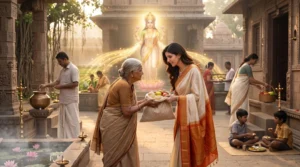
The Sanskrit word daan belongs to an entirely different universe. In our tradition, the giver does not stand above the receiver; the giver bows to the receiver. When we offer daan, we say the receiver has done us a favour by accepting it, because they have given us the opportunity to fulfil our dharma and purify our wealth. The highest form of giving in our scriptures is gupt daan, giving done in secret, where the left hand does not know what the right hand has given, where no plaque bears our name, and no camera records our generosity. The Bhagavad Gita classifies daan itself: sattvik daan is that which is given as duty, to the right person, at the right time and place, expecting nothing in return. Giving done for show, or with contempt, loses its spiritual value entirely even if it helps materially.
This is the heart of spiritual philanthropy: the understanding that giving is not primarily an economic act but a spiritual practice, a sadhana. It purifies the giver as much as it supports the receiver. Wealth, in the Sanatan view, is Lakshmi, divine energy that must circulate to remain auspicious. Hoarded wealth stagnates like blocked water; circulated wealth nourishes like a flowing river. The philanthropist, in this vision, is not a benefactor but a channel.
The Ancient Economics of Giving: The Wisdom of the Four Quarters
Here I want to share a teaching from our elders and rishis that deserves to be printed on the wall of every home and every business school because it reveals that our ancestors understood something modern economics is still struggling to articulate.
Money, they taught, has only four destinations: aside from earning, whatever we earn can be spent, saved, enjoyed, or given. And the health of a household, indeed of an entire economy, depends on the balance between these four. If a man earns a hundred rupees and spends ninety, his household collapses into debt. If he earns a hundred and hoards ninety, his household collapses into miserliness: crores in the cupboard and poverty in the kitchen, prosperity that nobody experiences. And yes, if he earns a hundred and donates ninety, his household collapses too, for even virtue without balance becomes destruction.
So our ancient wisdom prescribed the division of the four quarters: roughly a quarter of income for necessities, a quarter for comforts and joys, a quarter for savings, and a quarter for daan. Twenty-five percent for giving, not as a lofty ideal for saints, but as standard household arithmetic for ordinary families. Compare this with the modern world, where even the most celebrated philanthropic pledges make headlines at a fraction of that proportion, and you begin to see what kind of society our ancestors actually built.
And notice the genius of this model: it is simultaneously spiritual and economic. That twenty-five percent flowing continuously from lakhs of households sustained the entire social infrastructure of ancient Bharat: the pathshalas and gurukuls, the temples that functioned as community centres, the wells and dharamshalas, the care of cows and the feeding of travellers, all without waiting for a government department or a foreign NGO. Society funded its own welfare through the disciplined generosity of its members. Daan was not an interruption of the economy; it was a pillar of the economy. When this culture of balanced giving weakened, we did not merely lose charity; we lost a self-sustaining social security system that had run for millennia.
One Sacred River, Many Streams: Giving Across the Sanatan Family
I have always maintained that Sanatan Dharma, in its original breadth, is the shared spiritual foundation of the Vedic, Jain, Buddhist, and Sikh traditions one eternal river flowing in many streams. Nowhere is this unity more visible than in the philosophy of giving.
The Vedic tradition made daan one of the central duties of the householder and taught the yajna vision of life that one who cooks and eats only for himself, says the Gita, eats sin; food and wealth must first be offered, shared, circulated. The Jain tradition raised giving to exquisite refinement through the practice of daan as one of the primary duties of the shravak, with ahimsa ensuring that generosity extends to every living being, down to the smallest creature. The Buddhist tradition placed dana as the very first paramita, the first perfection on the path to enlightenment teaching that the journey to nirvana begins not with meditation but with giving. And the Sikh tradition gave the world perhaps the most magnificent living institution of spiritual philanthropy: the langar, where crores of people of every caste, faith, and status sit on the same floor and eat the same food, served by volunteers, funded by dasvandh, the tradition of dedicating a tenth of one’s earnings to the community.
Four streams, one essence: giving as worship. When the Sanatan Sanskrutik Sangh brings together saints of the Vedic, Jain, Buddhist, and Sikh traditions in initiatives like the Sanatan Ekta Yatra, this is part of what we celebrate: a shared civilizational conviction that no one prospers alone, and that the divine is served most directly through the service of beings. Such initiatives also reflect the importance of spiritual events in India, where diverse communities come together to preserve shared values, strengthen cultural harmony, and express devotion through collective seva. Vasudhaiva Kutumbakam the world is one family, is not a decorative slogan. It is the theological foundation of Indian philanthropy. You do not do “charity” for family members. You simply care for them, because they are yours.
The Many Forms of Daan: Beyond the Cheque Book
Modern philanthropy has become almost synonymous with money. Our tradition was far richer. It recognized that giving takes as many forms as human need itself.
Anna daan, the gift of food, was considered supreme among material gifts for hunger is the most immediate suffering, and a fed person is served completely, in body and spirit, in that moment. Vidya daan, the gift of knowledge, was considered even higher, for food serves a person for a day, but education serves them for a lifetime and their descendants for generations. Aushadhi daan, the gift of medicine and care for the sick. Abhaya daan, the gift of fearlessness, protecting the vulnerable, standing beside those who are threatened. Shram daan, the gift of one’s own labour and time, perhaps the most democratic of all gifts, for even the poorest person is wealthy in effort. And in our age, I would add kaushal daan, the gift of skills; the professional who teaches village youth accounting or coding is performing daan every bit as sacred as the donor who writes a cheque.
This breadth matters enormously, because it demolishes the excuse that philanthropy is only for the rich. In the spiritual framework, everyone is a potential philanthropist every single day. The retired teacher tutoring children for free, the young volunteer at a bhandara, the doctor giving one free day a week, the farmer leaving a corner of his field’s produce for the needy all are practising the same sadhana. Spiritual philanthropy is measured not by the size of the gift but by the purity of the bhaav behind it.
Why Modern Society Needs Spiritual Philanthropy
Now let us ask the harder question: why does this ancient framework matter to modern society, a world of CSR budgets, foundations, impact metrics, and donation apps?
Because modern society is suffering from diseases that money alone cannot cure, and modern philanthropy, for all its scale, often treats symptoms while the spirit remains malnourished. Consider what surrounds us: unprecedented wealth alongside unprecedented anxiety and loneliness; an epidemic of isolation as the collective structures that once held us the joint family, the mohalla, the village community dissolve into disconnected individuals with single incomes, multiple pressures, and zero safety nets; a widening gulf between those who spend fortunes in minutes and crores of fellow citizens who struggle for their daily bread; and a culture that measures human worth by consumption.
Into this landscape, spiritual philanthropy brings three things that conventional charity cannot.
First, it heals the giver. Modern psychology is only now confirming what our rishis declared millennia ago: that giving activates deeper contentment than acquiring, that service dissolves the anxieties of the isolated ego, that the surest cure for emptiness is usefulness. A society that practises daily giving is a society in therapy, and the therapy is free.
Second, it restores relationship. A tax-deductible online donation moves money; seva moves hearts. When you serve food with your own hands at a langar, when you teach a child face to face, when a business owner personally ensures his workers’ children are educated, the gulf between giver and receiver closes and becomes kinship. Spiritual philanthropy rebuilds, thread by thread, the social fabric that modern life has torn it recreates, in new forms, the collective resilience we lost when we abandoned our joint structures.
Third, it disciplines wealth. When giving is a fixed proportion of income rather than an occasional impulse, prosperity itself becomes sanctified. The businessman who has internalized the four-quarters wisdom does not need CSR regulations to compel him; his balance sheet has a conscience built into it. I say this as an entrepreneur myself: profit earned ethically and shared systematically is not merely acceptable in our dharma; it is celebrated. This same philosophy lies at the heart of social entrepreneurship in India, where enterprises seek to create lasting social value alongside sustainable economic growth. Lakshmi and seva are not rivals. They are meant to be partners.
My Own Path: Enterprise as a Vehicle for Seva
Everything I have written here, I attempt imperfectly, but sincerely to live. When I moved from Lalitpur to Mumbai and built ventures across finance, media, real estate, technology, and film production, I resolved that every enterprise would carry a second bottom line: cultural and social responsibility. Through Bharggav Ventures in Lalitpur, we remain engaged in philanthropy, education, and employment generation in Bundelkhand because a daughter’s first daan belongs to her own soil.

When the pandemic broke many of our plans and forced us to rebuild from the ground up, we chose to return through service wrapped in creativity. Our Hindi feature film, built on five stories of Indian values, was released across nearly seven hundred theatres in eleven states, and at every single show, we offered gifts to three viewers, deliberately reaching single-screen and rural audiences. It was a small gesture, but it embodied a principle: let even entertainment carry empathy; let every venture have a window through which giving flows. I have always believed that cultural films preserving Indian values can do more than entertain; they can preserve values, inspire reflection, and strengthen society’s connection with its civilizational roots. Art and daan, walking together.
And through the Sanatan Sanskrutik Sangh, guided by our ideals of Shanti, Shraddha, and Shaurya, our yatras and programs are acts of collective seva, serving society’s spiritual hunger, which is as real as physical hunger. Our forthcoming Vedic Pathshalas, beginning in Bundelkhand, are conceived entirely in the spirit of vidya daan: giving children the gift of their own roots, their own scriptures, their own Sanskrit, the one inheritance no misfortune can ever take from them.
Building a Culture of Giving: Where Each of Us Begins
If this vision moves you, let me suggest where it begins: not with grand gestures, but with the grandparent’s ten rupees. Restore the habit in your home: give your children a small amount regularly that is only for giving, and let them choose where. Adopt the discipline of proportion: whatever percentage you choose five, ten, or the full ancient quarter fix it, and let it flow every month like a sacred tax you pay to the human family. Give locally first: your street, your village, your workers, your watchman’s children. Vasudhaiva Kutumbakam begins at your doorstep. Give silently sometimes: perform one act of gupt daan each month that no one will ever know about, and notice what it does to your heart. Give your presence, not only your purse: one hour of shram daan binds you to society in a way no bank transfer can. And if you run a business, build seva into its structure: a fixed share of profit, a standing program, a door that never closes so that your enterprise serves even on the days you forget to.
Conclusion: The Civilization That Gives
Every civilization is remembered for what it accumulated. Ours deserves to be remembered for what it gave knowledge to the world without patents, food to travellers without questions, shelter to the persecuted of every faith without conditions, and the radical idea that the entire earth is one family whose members do not need a reason to care for each other.
Spiritual philanthropy is the daily practice of that idea. It is the grandfather’s coin in the child’s hand, the quarter of income flowing back to society, the langar’s shared floor, the anonymous gift, the taught child, the fed stranger. It asks of us not occasional heroism but constant humanity. And in a modern world that has more wealth and less peace than any age before it, I can think of no older medicine and no newer necessity.
When the roots of a tree are strong, no storm can bring it down. Giving is how a society waters its own roots. Let us begin a quarter, a coin, a meal, an hour at a time. As Haripriyaa Bharggav believes, lasting change begins not with extraordinary acts, but with the simple, consistent practice of seva, compassion, and giving woven into everyday life.