
By Haripriyaa Bharggav
In a village in Rajasthan, there is a scene that has stayed with me. A woman sits with her face fully veiled beneath a ghoonghat. From the outside, you can barely see a single hand. Around her, the men of the household are gathered, waiting on a decision that must be made. She makes one small gesture, and every man rises and moves to carry it out.
The most covered woman in the room was making every decision.
I share this not as a comment on veils or customs, but because it reveals a truth we have forgotten: the real power of the Indian woman was never absent. It was simply unseen and often unnamed. For too long, that power has been quiet, informal, confined to the four walls of the home. The work of Samarth Bharat is to call it out into the open to help women step forward not only as the silent strength behind their families, but as visible, confident leaders of their communities.
Samarth Bharat, the second pillar of SSS Bharat, means an empowered and capable India. And no India can call itself capable while half its strength, its Matru Shakti, the power of women remains untapped in the work of building society. This blog is about how Samarth Bharat encourages women to make that journey: from strength within the home to leadership within the community.
The Woman Was Never Weak the World Was Taught to Believe She Was
To understand where we are going, we must correct a lie the world absorbed long ago.
Look at how one civilisation treated its women. In much of the West, until as recently as 1950, a woman could not open a bank account, could not own property, and in many places could not vote. One of the most respected European philosophers even wrote that a woman had no soul, and therefore no capacity to know right from wrong and no right to make decisions. For centuries, women were treated as furniture, used and discarded.
Now look at our own civilisation. Our tradition declared, thousands of years ago: “Yatra naryastu pujyante ramante tatra devata,” where women are honoured, there the divine resides. While others denied women a soul, we worshipped the feminine as Shakti itself, the very energy that sustains creation. When much of the world would not let a woman handle money, the Rani of Jhansi was leading an army in 1857, and Ahilyabai Holkar was running an entire kingdom with wisdom and justice in the eighteenth century.
I say this not to boast, but to restore a memory that was stolen from us. The idea that the Indian woman is naturally meek, dependent, and unfit to lead is not our inheritance it is a colonial import, layered over centuries of our own reverence for the feminine. Samarth Bharat begins by rejecting that borrowed lie. Our women were never weak. They were, and are, Shakti. Our task is simply to help them reclaim what was always theirs.
What Makes a Woman Capable: The True Meaning of Samarth
If we are to empower women as leaders, we must be clear about what Samarth capability actually means. It is not merely a title, a position, or a salary. In the Sanatan understanding, true capability rests on three inner strengths, and these are the foundation of every real leader.
First independence. Genuine self-dependence: the ability to stand on your own soul, to draw your sense of worth and stability from within rather than borrowing it entirely from others. A woman who is independent in this deeper sense cannot be controlled by fear or approval.
Second acceptance. The maturity to meet a situation exactly as it is, including hardship, resistance, and setback, without collapsing before it. Leadership constantly meets reality that does not bend to our wishes. The capable woman faces it clearly.
Third tolerance. The strength to endure difficulty and rise through it rather than breaking beneath it. A leader carries weight that others cannot, and keeps walking.
A woman who has cultivated these three strengths is already a leader, whether or not she holds any formal title. And here is what gives me such hope: our women have been practising these qualities for generations in the endurance of the household, in the quiet management of families through hardship, in the patience and resolve that hold a community together. The raw material of leadership is already there in abundance. Samarth Bharat simply helps women recognise it, name it, and carry it beyond the threshold of the home into the life of the community.
From the Home to the Community: A Natural Expansion
There is a beautiful and important idea in our tradition about “self and others.” We are meant to work not only for ourselves, but for others, and the truly capable person expands their circle of care outward, from the self, to the family, to the whole community.
Women have always been the masters of this. Women in India have forever thought beyond themselves for their children, their elders, her home. Samarth Bharat asks only that we let that natural circle of care keep expanding. The same wisdom that manages a household can guide a village. The same strength that raises a family can uplift a community. The same compassion that nurtures children can shape schools, health, and dignity for hundreds.
This is why women make such extraordinary community leaders. Leadership, at its heart, is not domination; it is responsibility for the well-being of others. And that is a language women have spoken fluently for millennia. Moving from home to community is not a leap into something foreign for a woman. It is the natural widening of a river that has always flowed toward the care of others.
The tulsi image from our tradition captures it perfectly: the health of the whole plant lives in the strength of its root. Women are the root of the family, and the family is the root of society. When we strengthen and empower women, we are strengthening the root from which the entire community grows.
The Call: From Passive to Active
Here is the observation at the very centre of Samarth Bharat, and it applies with special force to women. In our society, real power often sits quietly at home, while those with far less genuine strength have gone out into the world to lead. The truly capable stay silent; the “unripe” step forward.
Our tradition gives a precise image. Only the mature, ripe leaves of a strong-rooted tulsi carry healing power; the unripe leaves cannot give what they do not possess. Today, too many of our most capable women, rich in wisdom, resilience, and moral strength, remain “at home,” telling themselves, “This is not my concern. My family is fine. Why should I step forward?”
That hesitation is the real barrier. The crisis of our time is not that women lack ability. It is the gap between capability and action. Many women have the wisdom but do not share it, the influence but do not use it, the strength but keep it hidden.
This is why Samarth Bharat is, above all, an invitation, and it is extended to every capable woman: “Every capable person, every successful individual, every Sanatani is invited to transform from passive to active.” From nishkriya to sakriya. From the strength that stays within the home to the leadership that lifts the whole community.
This is not a demand that women abandon their families or their values. It is an encouragement to let their existing strength serve a wider circle. A capable woman who steps forward does not lose her home; she extends its light outward, so that many more may be warmed by it.
Transformation Begins Within and Within Her
If there is one principle that empowers women most, it is this: transformation always starts from within.
We keep waiting for external systems to empower women: better laws, better schemes, better representation. All of these matter, and all are necessary. But no external system can awaken a woman who does not first recognise her own strength. Empowerment is not something handed down from above; it is something awakened within.
This is the deepest work of Samarth Bharat helping a woman see herself clearly: not as someone waiting for permission, but as Shakti already possessing everything she needs to lead. When a woman recognises her own independence, her own capacity to accept and endure, her own inherited strength, she stops asking whether she is allowed to lead and begins simply to lead.
And this inner transformation multiplies. A woman who steps into her strength becomes a living role model for every girl and woman who watches her. When a mother leads, her daughter learns that leadership is her birthright too. When one woman in a village steps forward, she quietly gives permission to a hundred others. This is how a generation of women leaders is born not through instruction alone, but through the visible example of women who have awakened their own power.
Matru Shakti in Action: Women Leading on the Ground
A vision means little until it lives in the real world. And through the work of the Sanatan Sanskrutik Sangh, Matru Shakti is being activated on the ground in ways that show exactly what women’s community leadership looks like.
Consider the great gatherings of women that have become a hallmark of this movement. At the Maha Kumbh in Prayagraj, thousands of women came together in a Samuhik Mahila Kalash Yatra, with over five thousand women carrying sacred water, walking in unison- an unmistakable demonstration of the divine feminine as the preserver of dharma and moral strength. Through Matrushakti Anushthans, women have gathered in the thousands to lead prayers and rituals for the nation’s well-being. These are not women in the background; they are women at the very centre, leading collective spiritual and social life.
This is a profound truth: when women unite for a higher cause, they become the living embodiment of Shakti, the force that sustains the world.
Beyond the great gatherings, the deeper work happens in the villages. Through the Total Village Development Programme (TVDP), women are being placed at the heart of rural transformation in health awareness, in education, in self-reliance initiatives. Because everyone who has served rural India knows the same truth: empower the women of a village, and the entire village rises. Women are not one beneficiary among many in community development. They are its most powerful engine.
Young Women: The Leaders of Tomorrow
We must give special attention to our young women because the future of community leadership rests with them.
For too long, and in too many places, the strength of young women has been overlooked, their ambitions quietly discouraged, their leadership left unimagined. Samarth Bharat says the opposite: educate our daughters, back their dreams, honour their capability, and prepare them not merely to participate in society but to lead it.
This is where Yuva Shakti, the power of youth, and Matru Shakti, the power of women, meet in their most potent form: in the young woman who is rooted in her heritage, confident in her identity, capable in her inner strength, and moved to serve her community. She is the answer to the crisis of our age. She can compete anywhere in the world without losing herself, face any storm without breaking, and lead without ever abandoning her values.
The practical wisdom I offer every parent and mentor is simple: alongside education, give values; alongside opportunity, give identity; alongside ambition, give roots. A young woman raised this way becomes something extraordinary: capable and grounded, modern and rooted, a leader the whole community can trust. When our young women rise strong and rooted, the whole of Bharat rises with them.
A Nation That Honours Its Women Cannot Fall
Let me return to that veiled woman in the Rajasthan village, making every decision with a single gesture. Her power was real, but it was hidden, informal, confined. The journey of Samarth Bharat is to take that same immense strength and bring it into the full light of community leadership, where it can shape not just one household, but the destiny of villages, towns, and the nation itself.
We are not importing women’s empowerment from anywhere. We are reclaiming it, restoring a civilisation that once worshipped the feminine as Shakti, that produced Rani Lakshmibai and Ahilyabai, that declared the divine dwells wherever women are honoured. Samarth Bharat simply asks us to live up to our own highest truth.
To every woman reading this: you are not waiting for strength; you already carry it. You are Shakti. Your independence, your resilience, your endurance, your compassion these are not weaknesses to be managed but powers to be unleashed for your community. Do not let that power stay silent behind the walls of the home. Let it step forward. Move from passive to active. Become the leader your village, your town, your nation is waiting for.
As I often say: “When the roots of a tree are strong, no storm can bring it down, and when the roots of our culture are deep, no force can weaken our identity.” Women are the root of our society. When we empower them to lead, we are strengthening the very root of Bharat, and a nation whose women lead is a nation that can never be brought down.
That is how Samarth Bharat empowers women to become community leaders. And that transformation begins with each woman who decides to rise.
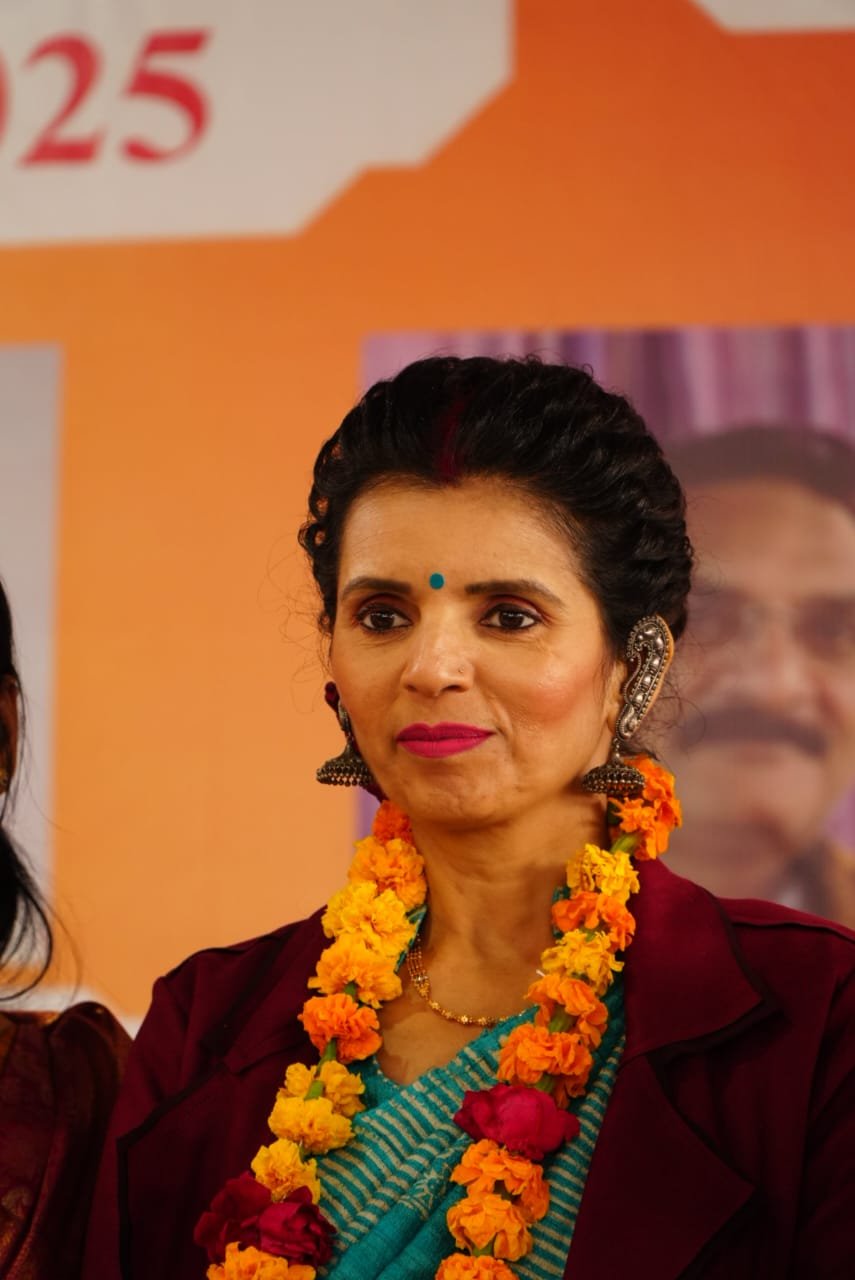
Haripriyaa Bharggav is an entrepreneur, philanthropist, and cultural leader, and the Chairperson of the Sanatan Sanskrutik Sangh a movement dedicated to reviving India’s cultural consciousness, empowering women and youth, and building a self-reliant, dharmic Bharat.










1 Comment
Ways Communities Can Support the SSS Bharat Movement
[…] not simply as a large gathering but as a demonstration of organized women’s leadership and women as community leaders. At a community level, women’s groups can contribute […]